Do English Teachers Really Overanalyze Everything? A Better Way to Teach Symbolism
Disclosure: This post contains Amazon affiliate links. If you purchase through these links, I may earn a small commission at no additional cost to you.
In my first year teaching 8th grade, one of my students accused me of doing "the English teacher thing."
We were reading Ray Bradbury’s “A Sound of Thunder,” and I suggested that the story's central message was that small actions can have enormous consequences.
He rolled his eyes.
"I think you're reading too much into it."
I laughed.
Because... sure, English teachers don't exactly have a reputation for restraint.
If you've spent any time on the internet, you've probably seen the jokes.
"The curtains are blue because the author liked blue."
And yeah… I’ve wondered that too.
Are we actually uncovering intentional symbolism...
...or are we just really good at making convincing arguments?
The answer is probably a little bit of both.
But come on.
This is a story about a man stepping on a butterfly in the Jurassic period and accidentally changing the outcome of a presidential election millions of years later.
If Bradbury wanted us to believe the story was simply about butterfly conservation... he certainly picked an interesting way to say it.
If that was “doing the English teacher thing” this kid would be appalled by the lit analyses I wrote about Emily Dickinson’s work in college.
Yikes!
At the time, I didn't have a great answer.
A few years later, I decided to change my approach to teaching literary analysis.
Instead of just telling students that white symbolizes purity— trust me.
I decided I needed to prove it.
For students to identify symbolism themselves, they have to believe that intentional symbolism exists.
And for them to believe that intentional symbolism exists, they have to hear artists discussing their process.
Enter Khan Academy’s Pixar in a Box, which has dozens of videos about character design and other storytelling techniques.
Videos of Disney-Pixar animators explaining why they chose a certain shape? Sign me up!
Did you know Anton Ego is intentionally shaped like a coffin to invoke a sense of dread?
Did you know Carl from Up is bulky and square to complement Ellie’s soft, circular features? He is the stability to her whimsy.
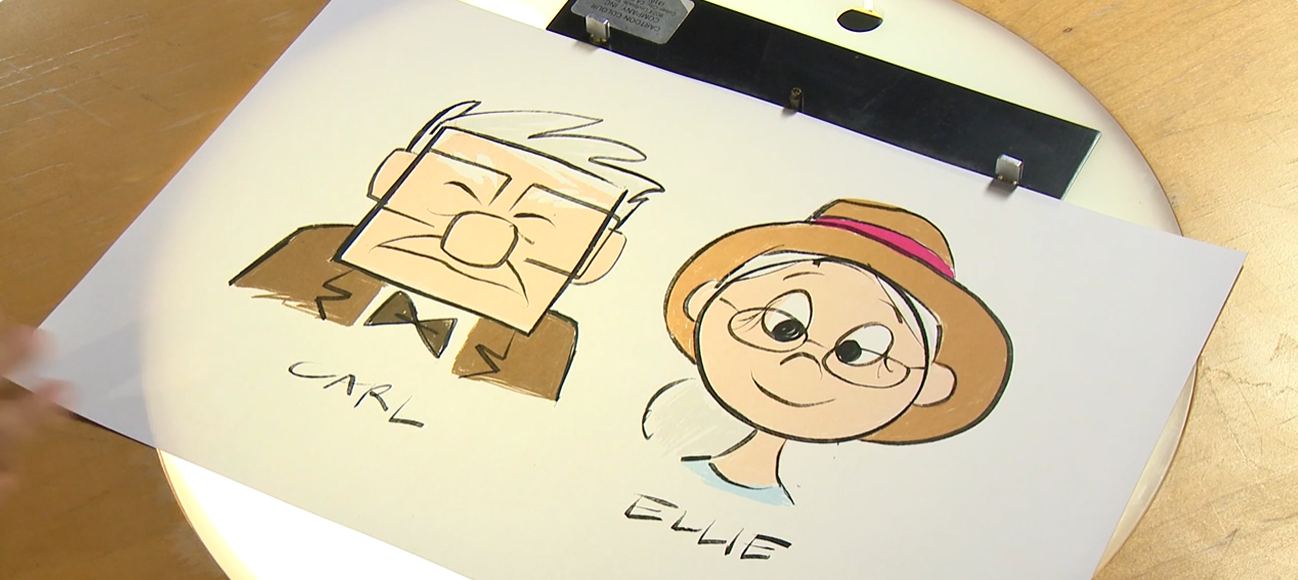
Screenshot from Khan Academy’s Video, Shape: https://www.youtube.com/watch?v=twlbbFITOxg
Sharing these videos with students was powerful.
Suddenly…
it wasn't my interpretation anymore.
It was the artists’ vision!
These videos sent me down a rabbit hole.
I was determined to learn more about animator’s choices from Khan Academy and Creativity, Inc. by Pixar’s Ed Catmull.
I also learned about the psychological influence of various colors and shapes from Ingrid Fetell Lee’s Joyful: The Surprising Power of Ordinary Things to Create Extraordinary Happiness.
But each of those resources focused on one tiny piece of the puzzle.
I wanted students to see the bigger picture—to understand how color, line, shape, texture, and symbolic objects all work together to communicate meaning and why we respond to them the way we do.
So I wrote the article I now wish I’d had when I first started teaching: “Symbolism: The Relationship Between Art & Human Emotion.”
I now read this with my 8th graders each year, while constantly stopping to examine examples from Disney and Pixar films.
Students aren’t just taking my word for it anymore.
They have evidence that "that English teacher thing" isn’t just mumbo jumbo.
Professional artists make these decisions intentionally.
Reading the article together is such a fun experience, because I pair it with a slideshow full of characters that showcase the points I’m making.
Why are so many Disney villains composed of sharp angles? Because our evolutionary roots encourage us to fear sharp objects… It makes sense.
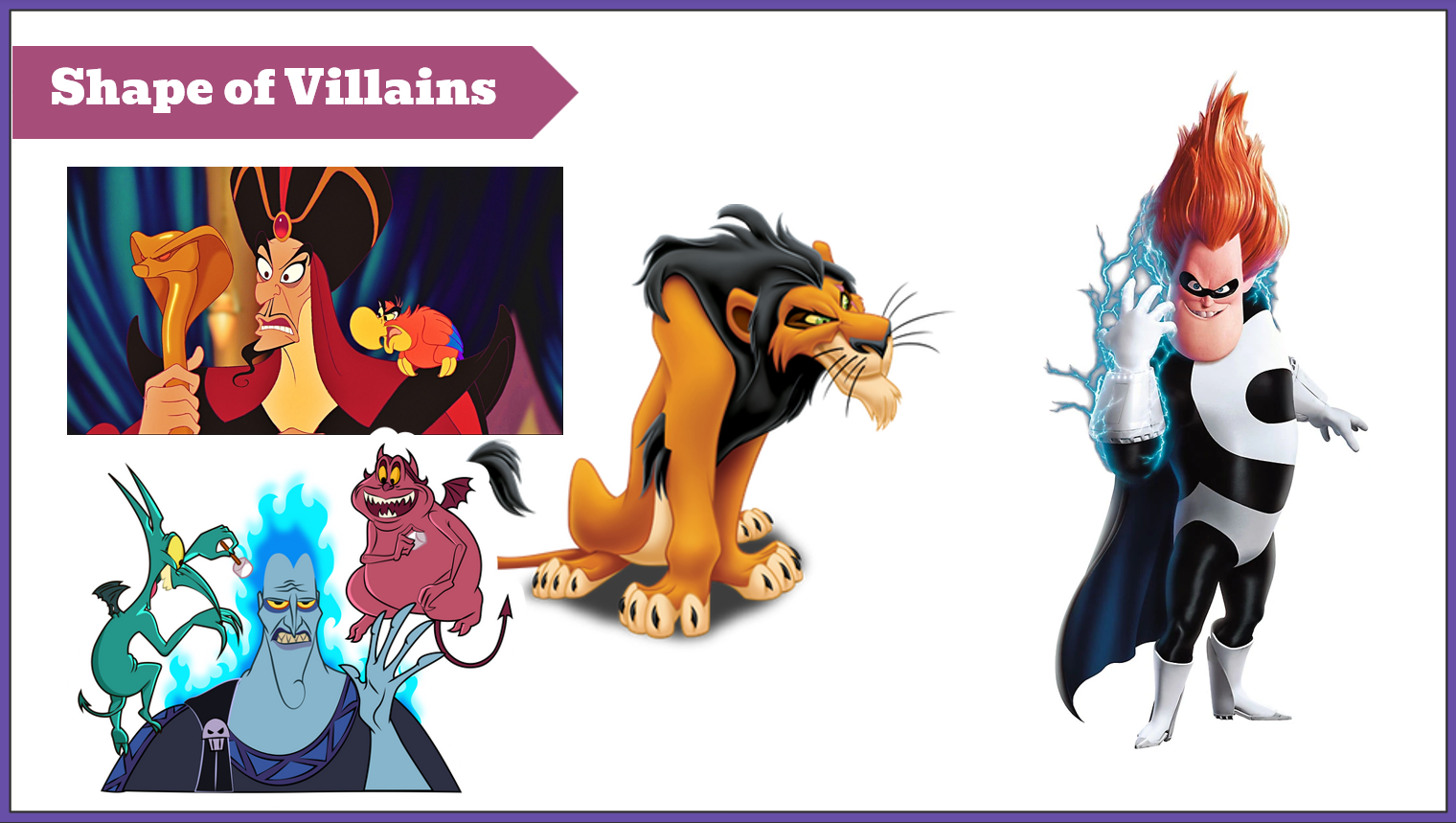
One of my favorite classroom moments happened when we were discussing Disney’s use of dark colors when portraying villains.
Of course, the moment you make a broad claim in front of middle schoolers, their life mission becomes finding the exception.
And I do make it clear that these are not hard and fast rules—just patterns.
But one student brought up Prince Hans.
"He doesn’t wear dark colors. He wears white!”
“Interesting… Let’s look it up!”
The class was on pins and needles as I typed his name into Google.
His image flooded the screen.
A student gasped.
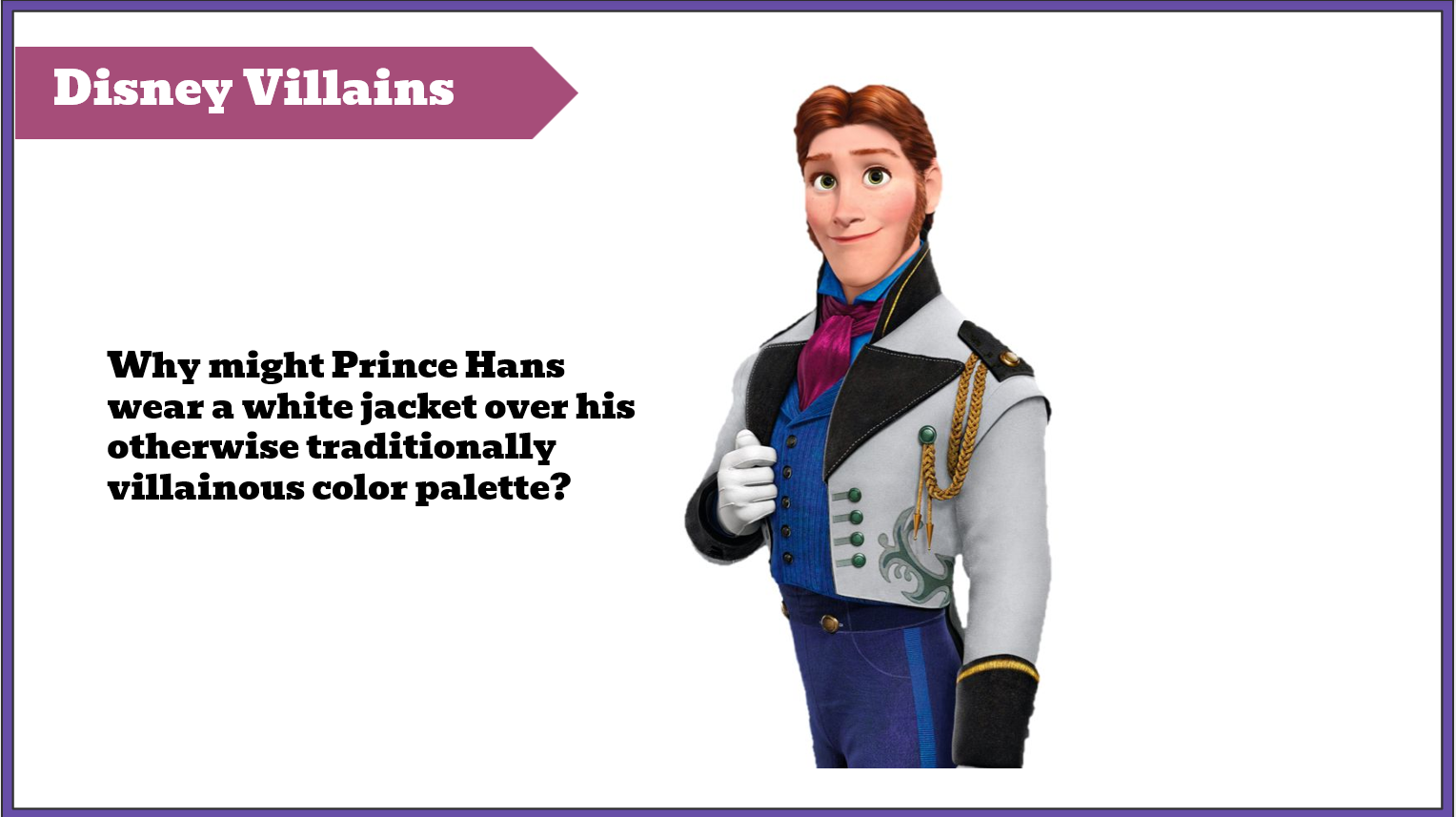
He's actually wearing a white military jacket...
...over dark purple clothing.
The theories started flying.
"It’s because he’s pretending to be good."
"The white is hiding who he really is."
"The purple was there the whole time, but nobody noticed.”
Authentic literary analysis was happening right before my eyes.
The thesis?
Hans isn't wearing white. He's hiding behind it.
Did Disney ever confirm that interpretation?
No, of course not.
Could there be other explanations?
Absolutely.
But whether Disney intended this exact interpretation is almost beside the point.
The students had learned to support their ideas with evidence instead of simply guessing what I wanted them to say.
They were applying design principles they had already learned from professional animators.
They had evidence.
And they were analyzing literature (even if that literature was a children’s film).
👉 Read this blog post about the importance of pop culture in literary analysis.
That’s why I no longer ask students to believe symbolism exists because English teachers say it does.
I show them artists obsessing over line.
Color.
Shape.
Texture.
Objects.
Once students realize that professional storytellers intentionally make these decisions...
they stop asking,
"Are we overthinking this?"
and start asking,
"Why did the artist make that choice?"
Recreate these discussions in your classroom with
👉Pop Culture Symbolism
What’s included?
✓ Original article: “The Relationship Between Art & Human Emotion”
✓ Instructional slides to guide discussion
✓ Links to recommended Khan Academy videos
✓ Short film analysis: Pixar’s “Float” (requires access to Disney + , though the instructional framework and analysis templates can easily be applied to other publicly available short films. Suggested alternatives are provided and linked within the resource.)
P.S. The student I mentioned at the beginning of this story came to visit me after taking freshman and sophomore English.
"Remember when you told me I was reading too much into A Sound of Thunder?" I asked.
He laughed.
"Compared to high school... you weren't reading into it enough."
I’ll consider that a win.
Disney, Pixar, and the characters referenced here are trademarks of their respective owners. This article is an independent educational commentary and is not affiliated with or endorsed by Disney or Pixar.
