Students Analyze Stories Every Day
When I tell people I use pop culture in my middle school ELA classroom, I usually get one of two reactions.
The first is excitement.
The second is concern.
"But shouldn't students be reading the classics?"
Absolutely.
I'm not suggesting we replace The Outsiders, Romeo and Juliet, or A Christmas Carol with Disney movies and Taylor Swift songs.
I'm suggesting we build a bridge.
Because here's the truth: My students don't spend their weekends discussing symbolism in nineteenth-century literature.
But they absolutely spend them arguing over Marvel movies.
They debate whether a Disney villain was actually misunderstood.
They memorize song lyrics.
They predict plot twists.
They quote commercials.
They analyze social media.
They just don't realize that's what they're doing.
The problem isn't that students can't think critically.
The problem is that we often ask them to practice literary analysis on texts they haven't learned to care about yet.
Meet Students Where They Already Are
As teachers, we often feel pressure to jump straight into grade-level texts (or higher).
And obviously, we need to do that.
But if students are still learning what symbolism, theme, irony, or figurative language actually look like, why not introduce those concepts using stories they're already invested in?
The goal isn't to water down rigor.
The goal is to remove unnecessary barriers so students can focus on the thinking.
When students already understand the story, they're free to analyze it deeply. Instead of spending all of their mental energy figuring out what happened, they can spend it asking questions like:
Why did the author make that choice?
What message is the story communicating?
What does that symbol represent?
Why is that irony effective?
That's where the real learning begins.
My Favorite Pop Culture Entry Points
🎵 Song Lyrics
Music is poetry.
In many ways, its the poetry our students know best.
Any literary skill you can teach through poetry, you can teach through popular songs your students already love first.
Figurative language suddenly isn't something students memorize for a quiz.
It's something they begin noticing every time they turn on the radio.
One of my favorite classroom activities is Classroom Jukebox, where students identify figurative language in popular songs while competing for points.
Seriously— They beg to keep playing so they can beat their high scores.
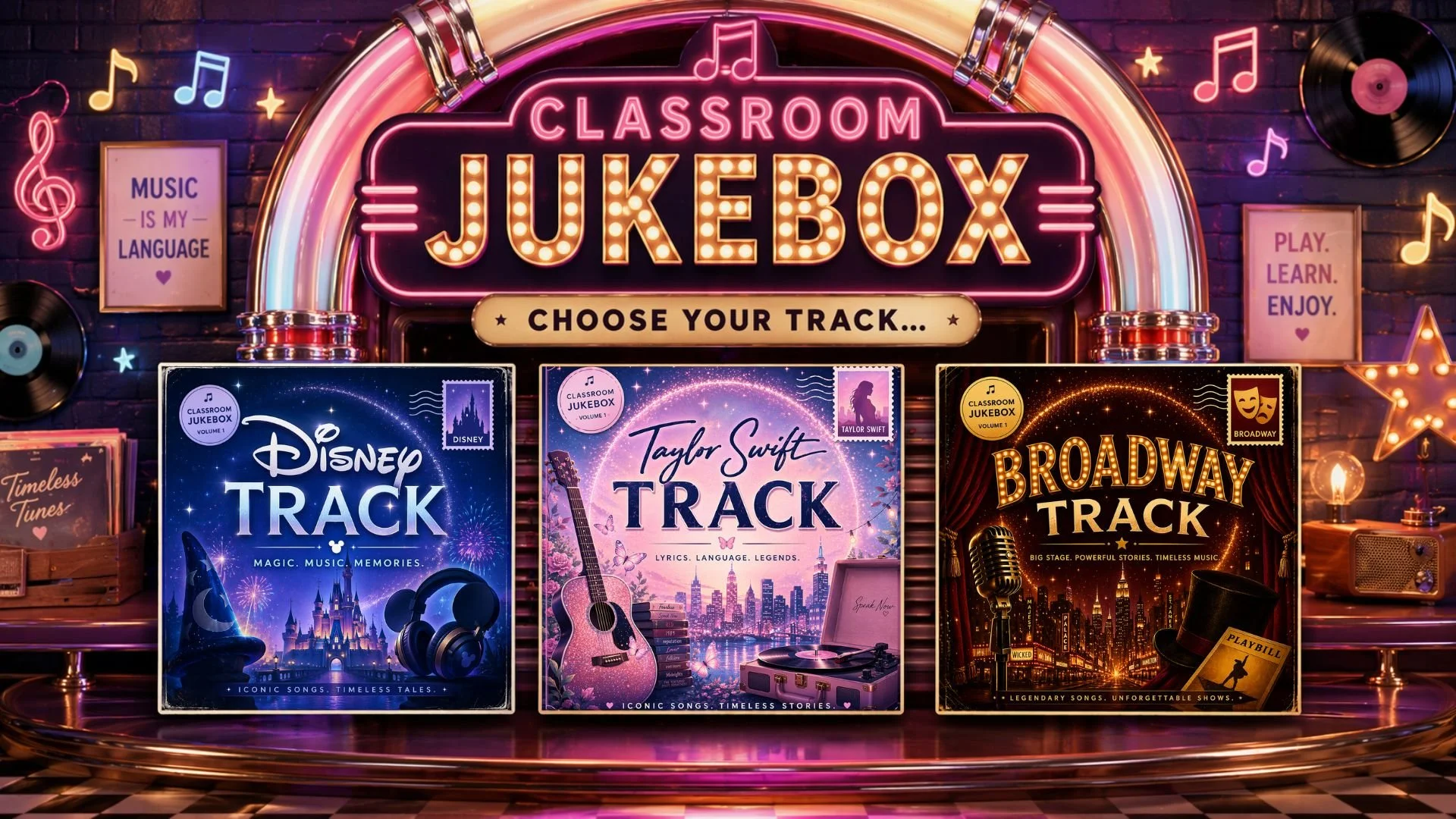
Click the image to recreate this experience in your classroom.
But the best part isn't the competition.
It's what happens afterward.
Students start recognizing metaphors, hyperbole, similes, and personification everywhere.
The skill follows them outside the classroom.
It’s transferrable—and that’s the goal.
🎬 Short Films
Short films have become one of my favorite teaching tools.
They're engaging.
They're easy to fit into a single class period.
And because students aren't overwhelmed by pages of text, they can devote all of their attention to the analysis.
I regularly use short films to introduce concepts like:
👉 Theme
Students still gather evidence.
They still defend their thinking.
They still have meaningful discussions.
They're just doing it through an accessible, bite-sized medium that immediately captures their attention.
Once those analytical skills are established, transferring them to novels and short stories becomes much more natural.
Pop Culture Isn't the Destination.
It's the on-ramp.
This is probably the biggest misconception about using pop culture in the classroom.
The goal isn't simply to entertain students.
The goal is to build transferable thinking skills.
Once students learn how to identify symbolism in a Pixar short film, they’re much more prepared to recognize symbolism in The Giver.
Once they can explain the theme of a short film, they're ready to discuss the theme of a novel.
Once they understand figurative language in song lyrics, they're better equipped to analyze diction in a novel or poetry.
Pop culture isn't replacing rigorous literature.
It's preparing students for it.
Start with Familiar Stories. End with Deeper Thinking.
I've found that students become much more confident literary analysts when they realize they already know how to think this way.
They've been analyzing stories for years.
They just needed someone to help them recognize it.
When we meet students where they are first, the discussions become richer. Students begin making connections on their own.
And literary analysis stops feeling like another school assignment.
It starts feeling like the way they naturally experience stories.
Ready to Bring Pop Culture into Your Classroom?
✨If you're looking for ready-to-use lessons that use short films, song lyrics, and other familiar media to teach literary analysis, I've already done the searching, planning, and lesson design for you.

My Pop Culture Literary Analysis bundle includes 5 ready-to-use resources that will help your students build foundational literary analysis skills. Each resource can be purchased individually as well.
❤ "Great and engaging resource for my 8th graders to get them thinking about a theme which can be a difficult topic to grasp and beyond those one-word topics. They really enjoyed these clips especially the shorts." —Deidre S.
❤ "The students were engaged and really enjoyed the tie-in with Pixar! Thanks so much for creating this great tool!" —Jeffrey H.B.
❤ "I love this resource! My older students tried to pretend they were 'too cool' but after about 2 minutes, they were hooked (engaged)! Definitely a win!" — Deyetta J.
❤ "My students love these resources and really grasp the concepts. They tend to be easily distracted but were able to focus and seemed interested in the subject matter." — Casey D.
👉 Figurative Language Review Game | Classroom Jukebox (Song Lyrics Activity)
❤ Includes Taylor Swift, Disney, and Broadway tracks
❤ Includes an article about how successful animators symbolically design their characters
❤ Students learn situational, dramatic, and verbal irony through clips of popular films
Figurative Language Review Game | Classroom Jukebox (Song Lyrics Activity)
Figurative Language Review Game | Classroom Jukebox (Song Lyrics Activity)
