Every Great Story Has Something to Say— What Pixar’s Storytelling Rules Teach Us About Theme

You may already be familiar with Pixar's famous 22 Rules of Storytelling.
One of my favorites is Rule #14:
"Why must you tell this story? What's the belief burning within you that your story feeds off of? That's the heart of it."
I love that rule because, whether Pixar intended it or not, it's also one of the best explanations of theme I've ever encountered.
It reminds us that every memorable story exists for a reason.
It has something to say.
It has something to leave with us after the final page is turned or the credits begin to roll.
It might sound a little dramatic, but I also think it's true.
If Finding Nemo were really just about a clownfish searching for his son, audiences wouldn't leave the theater feeling changed.
If The Outsiders were simply about two rival gangs, we wouldn't still be teaching it nearly sixty years after it was published.
If Inside Out were only about the emotions inside a little girl's mind, it wouldn't resonate with adults as deeply as it does with children.
Great stories are never just about what happens.
They're about the burning belief that inspired them—the truth they're trying to communicate.
That's theme.
Theme Is the Heart of Every Story
When students first encounter theme, they're often told it's simply "the message" of a story.
But that's a surprisingly abstract idea.
I actually think Pixar's Rule #14 gives us a much richer way to think about it.
Every great storyteller has something they believe.
Something they hope audiences will wrestle with.
Something they hope stays with us long after the story ends.
That's why Finding Nemo isn't really about a fish searching for his son.
It's about learning to let go.
It's why The Outsiders isn't really about rival gangs.
It's about identity, empathy, and recognizing our shared humanity.
The plot gives us something to follow.
The theme gives us something to remember.
The Question That Unlocks Theme
When I teach theme, I don't begin with definitions.
I begin with curiosity.
First, students identify the big ideas a story explores.
Then I ask one simple question:
What does the author want us to know about those ideas?
That question changes everything.
Instead of searching for a "right answer," students begin searching for meaning.
They're no longer asking,
"What happened?"
They're asking,
"What was the author trying to tell me?"
Those are the conversations literary analysis is built on.
Why I Start with Short Films
When it comes to theme, Pixar has another invaluable resource to offer Language Arts teachers—its short films.
The biggest reason I love teaching theme this way is that short films are bite-sized and immediately accessible.
Students aren't trying to keep ten characters straight (Naming your main characters Darry and Dally? Looking at you, S. E. Hinton. 👀).
They're not getting stuck on unfamiliar vocabulary.
They're not worrying about remembering twenty chapters worth of plot.
They're free to focus on the thinking.
Instead of asking,
"Wait...what happened?"
they're asking,
"Why did that ending resonate with me?"
"What was the creator trying to tell us?"
Those conversations naturally lead students toward stronger literary analysis, and once students can identify the message in a five-minute short film, they're much more confident doing the same thing with a full-length novel.
Why Theme Matters Beyond English Class
Theme isn't just another literary term students memorize before a quiz.
It's one of the reasons stories matter in the first place.
Stories help us understand ourselves.
They challenge our assumptions.
They remind us we're not alone.
They allow us to experience lives we've never lived and perspectives we've never considered.
In doing so, they expand our empathy and deepen our understanding of the world around us.
When students learn to recognize theme, they're learning to ask one of the most important questions a reader can ask:
What is this story trying to tell me?
That's a skill they'll use long after they leave English class.
Whether they're watching a movie...
Listening to a song...
Reading a novel...
Or someday writing stories of their own.
Because every great story has something to say.
And giving students the tools to discover those messages might be one of the most meaningful things we can teach.
Ready to Help Students Discover the Heart of a Story?

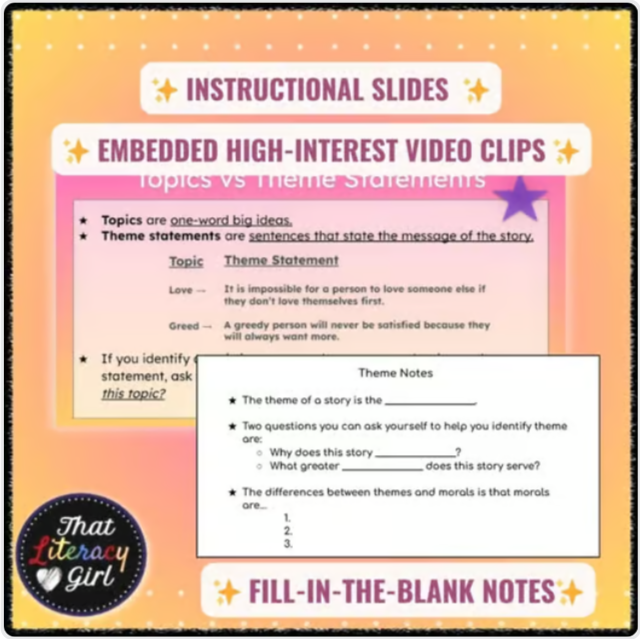

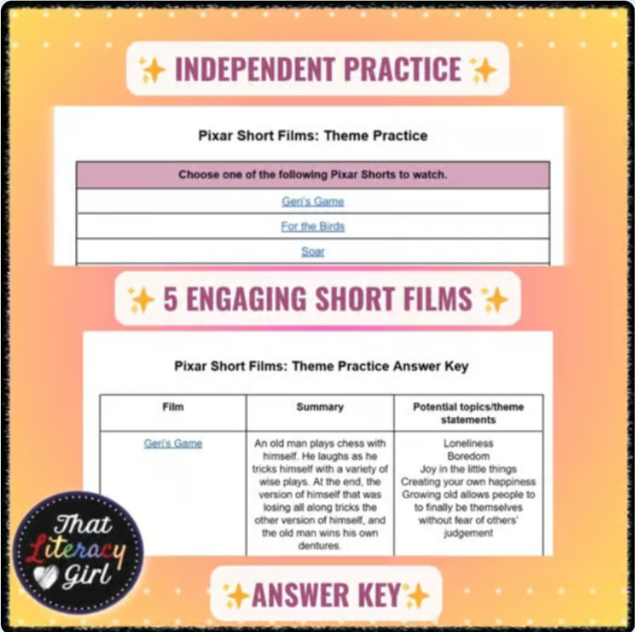
If you're looking for a ready-to-use lesson that helps students move beyond one-word topics and write thoughtful, evidence-based theme statements, my 👉 Teaching Theme with Short Films lesson was designed to do exactly that.
Students learn to:
distinguish between topics and themes,
ask what an author wants readers to understand,
write stronger theme statements,
and support their thinking with evidence from engaging Pixar short films.
Because once students understand that every story has something to say, they're no longer just identifying theme— they're learning to read with purpose.
