5 Common Mistakes Students Make When Identifying Theme (And How To Fix Them)
If you've ever asked students to identify the theme of a story, you've probably seen answers like these:
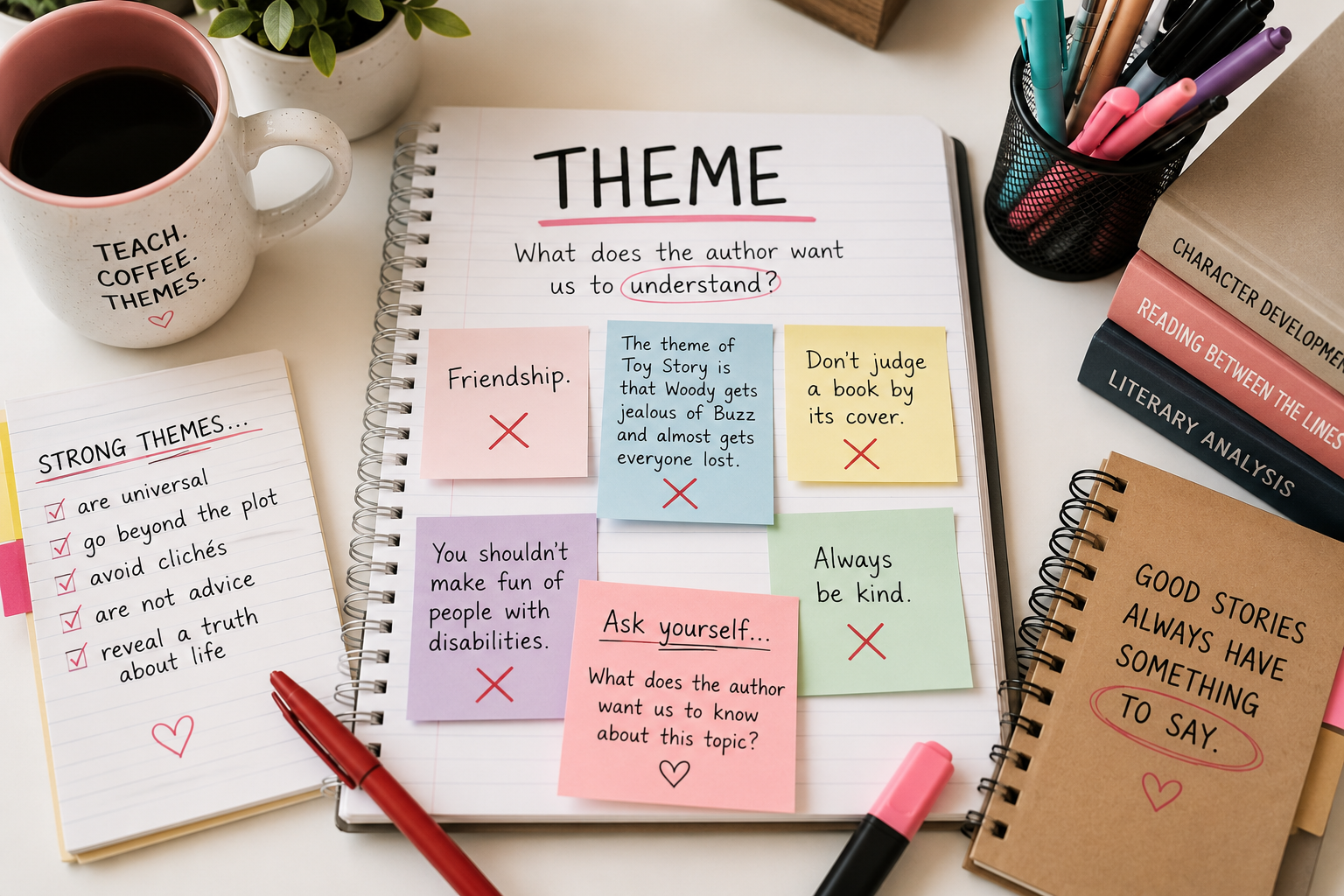
Friendship.
Don't judge a book by its cover.
The theme of Toy Story is that Woody gets jealous of Buzz and almost gets everyone lost.
They're all attempts at identifying theme.
But none of them quite get there.
The truth is, theme is one of the hardest (and most important) literary concepts we teach—not because students aren't capable of understanding it, but because it requires them to move beyond simply remembering what happened and begin thinking about what the story actually means.
Over the years, I've noticed students making the same five theme-related mistakes again and again.
Fortunately, once students recognize these patterns, writing thoughtful theme statements becomes much easier.
Mistake #1: They Identify the Topic Instead of the Theme
This is by far the most common mistake.
Students write:
Friendship
Family
Courage
Identity
Forgiveness
Those aren't themes.
They're literary topics.
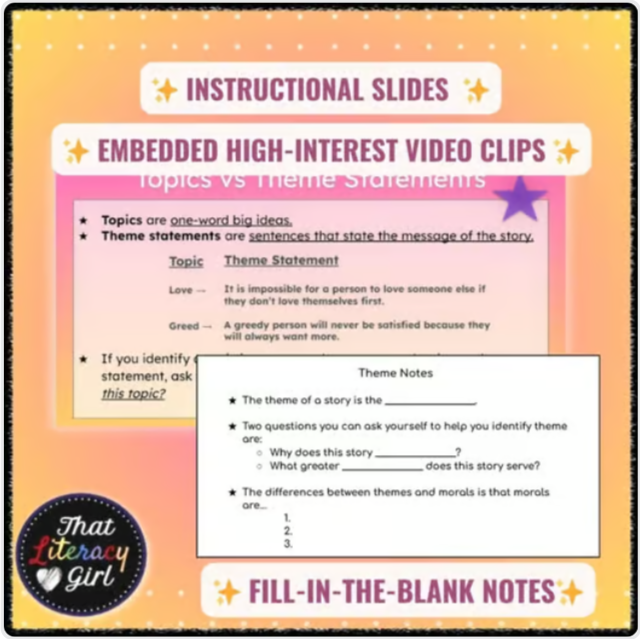
Topics are one-word ideas that tell us what a story explores.
Theme tells us what the author wants us to understand about that topic.
I tell my students to think of the topic as the starting point—not the finish line.
Once they've identified the big idea, we ask:
What does the author want the reader to know about this topic?
That's how we move from comprehension to analysis.
Mistake #2: Their Theme Is Really Just the Plot
Students often stay too close to the events of the story.
For example:
The theme of Toy Story is that Woody lets his jealousy of Buzz get the toys into danger.
That's not really theme.
It mentions a literary topic—jealousy—but it's still just a summary of the plot.
A stronger theme steps back from the specific characters and asks:
What larger truth does this reveal?
Instead, students might write:
Jealousy can cloud our judgment and damage our relationships.
or
Insecurity often leads us to make choices we regret.
Those extend beyond Woody and Buzz.
Someone who has never seen Toy Story could still understand—and relate to—them.
That's what makes a theme universal.
I often tell students that for their statement to be considered a theme:
“Everyone with a beating heart should understand it.”
That doesn’t mean that everyone has experienced it.
It simply means that they’re familiar with the topic and can comprehend the message (whether they’ve read the story/watched the film or not).
Mistake #3: They Write Advice Instead
This one never fails.
Many students write theme statements like:
You shouldn't make fun of people with disabilities.
or
Always be kind.
While those messages may be well-intentioned, they're actually not themes at all. They’re just… advice.
Themes are observations about life.
Instead of writing:
You shouldn't make fun of people with disabilities.
Students might write:
If a person overlooks someone with disabilities, they will miss out on that person’s strengths.
The first tells readers what to do.
The second helps readers understand something about the human experience.
A theme shouldn’t be simply “Do x” or “Don’t do y.” It should reveal something true about the consequences of our choices, our relationships, or the human experience.
That's what authors do.
They don't just hand readers a list of rules.
They reveal truths through stories.
Mistake #4: They Rely on Clichés
Another common habit is reaching for the low hanging fruit— those clichés we’ve all heard 1,000 times.
Students write things like:
Don't judge a book by its cover.
Love conquers all.
Be yourself.
Those ideas aren't necessarily wrong.
But aside from the fact that they’re often framed as advice (like those above), they’re also so broad and overused that they no longer resonate with people.
They’re overdone.
Additionally, they could be applied to hundreds of different stories.
Instead, encourage students to ask:
What makes this story unique?
Does it really exist merely to reinforce a cliché message we’re all familiar with already?
Strong theme statements grow out of the specific choices an author makes—not out of phrases we've heard a hundred times before.
Mistake #5: They Forget to Ask What the Main Character Learned
When students get stuck identifying theme, I encourage them to look at one character in particular: The protagonist.
By the end of most stories, the main character has changed— that’s what good stories are about, after all— growth.
Typically the protagonist has had their beliefs challenged or changed, they’ve learned a lesson, or they've discovered something about themselves and the world around them.
More often than not...
What the main character learns is exactly what the author hopes readers will learn too.
Take Finding Nemo.
Marlin doesn't just find his son. He learns to let go—to trust.
To allow Nemo to take risks and grow.
That lesson becomes one of the central themes of the story.
The same pattern appears again and again in literature.
When students ask,
"What did the main character learn?"
they're often only one step away from answering,
"What does the author want readers to understand?"
It's not a perfect strategy for every story.
But it's one of the simplest ways to help students move beyond plot and toward meaning.
Theme Is More Than a Literary Term
One of the reasons I love teaching theme is that it reminds students every story has something to say.
Authors don't spend months—or years—writing stories simply to entertain us.
They write because they have an idea they can't stop thinking about.
A question they want readers to wrestle with.
A truth they hope stays with us long after the final page.
Helping students uncover those ideas isn't just preparing them for the next novel.
It's helping them become more thoughtful readers—and, eventually, more thoughtful writers.
Ready to Help Students Move Beyond One-Word Themes?
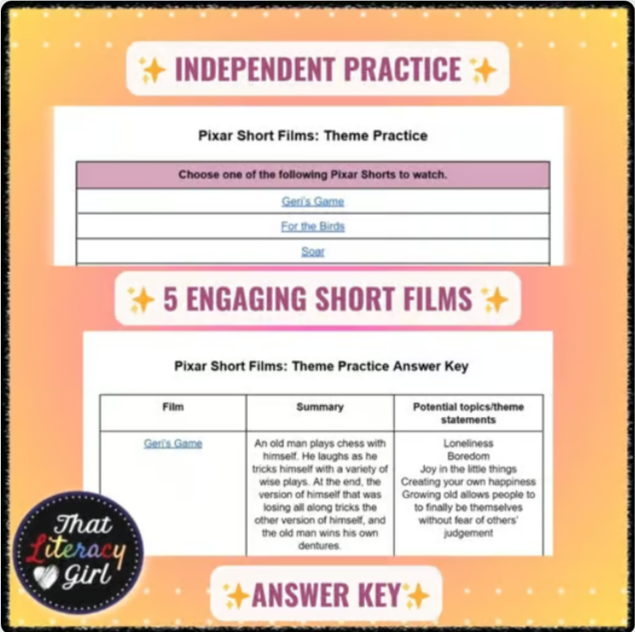
These are exactly the misconceptions my Teaching Theme with Pixar Short Films lesson was designed to address.
Instead of memorizing a definition, students learn how to:
distinguish topics from themes,
move beyond plot summaries,
avoid clichés,
write stronger theme statements,
and support their thinking with evidence.
Using engaging short films, students practice the kind of thinking they'll later apply to novels, short stories, and everything else they read.
Because once students understand that every story has something to say, they're no longer guessing at theme.
They're discovering meaning.