The Real Goal of Teaching Figurative Language: 5 Strategies That Actually Work
The Real Goal of Teaching Figurative Language
One morning, a student eagerly shouted my name as he entered my classroom, “Mrs. Jeffery!”
I smiled and greeted him— “Well, hello! I’m happy to see you too!”
“No!— well, sure… that too—but I heard personification on the radio this morning!”
I gasped. “No! In the wild!?”
“Yeah, for real.”
He went on to tell me the lyrics (which I honestly don’t remember anymore), but he was right! It was personification.
I was so excited to see him not just identifying figurative language on a worksheet or circling the correct example on a multiple choice quiz, but actually noticing it—Finding it himself! In music that resonated with him.
Ever since then, that’s my goal when teaching figurative language—to help students become readers who naturally recognize poetic devices wherever they encounter it whether that’s in a novel, a movie, or a song on the radio.
And that completely changed how I taught.
Identifying Figurative Language Isn't the Same as Noticing It
Teaching figurative language could no longer be about memorizing definitions in isolation. It had to be about training students to find figurative language on their own.
Once I started teaching it this way, I realized how incomplete my previous approach had been.
When I'd give students examples of figurative language, they could usually identify the correct literary device without much trouble.
But that’s because I— a literacy teacher with a master’s degree—was choosing the examples.
I was carefully selecting metaphors they could recognize, clear examples of personification, familiar idioms, etc.
But real books don't do that.
Authors don't pause to announce, "Hey! Look— a simile!”
When students are set free to find figurative language on their own, suddenly they're not sure whether they're looking at an idiom, a metaphor, or simply a cleverly worded sentence.
And that's exactly why this matters.
When students don't notice figurative language, they're missing far more than a quiz question.
They're missing one of the primary ways authors create emotion.
After all, figurative language isn't just decorative.
It's persuasive.
It's memorable.
It's the reason certain lines linger in our minds long after we've finished the book.
It's what transforms...
The sun set.
into...
The last rays of sunlight melted into the horizon, leaving the sky awash in navy and gold.
The words don't simply communicate information.
They create an experience.
And if students never become fluent enough to recognize those choices while they're reading, they'll never become intentional enough to make those choices in their own writing.
Recognition Comes Before Creation
Long before students can write powerful metaphors, craft vivid imagery, or weave subtle allusions into their own work, they first have to notice how other authors do it.
That's why I no longer teach figurative language as a vocabulary list to memorize.
I teach it as something students should start seeing everywhere.
And once they notice it...
I want them asking one more question:
Why did the author choose to write it this way?
How does this metaphor, simile, or personification change the way I experience the story?
Because that's when figurative language stops being a literary term...
...and starts becoming a writing tool.
So... how do you teach students to notice figurative language?
Step 1: Start with pop culture
![1[1].jpg](https://images.squarespace-cdn.com/content/v1/6a14915954f7a8487d3d0358/1784058577706-WP7TIRJR4PW390ZXM7HS/1%5B1%5D.jpg)
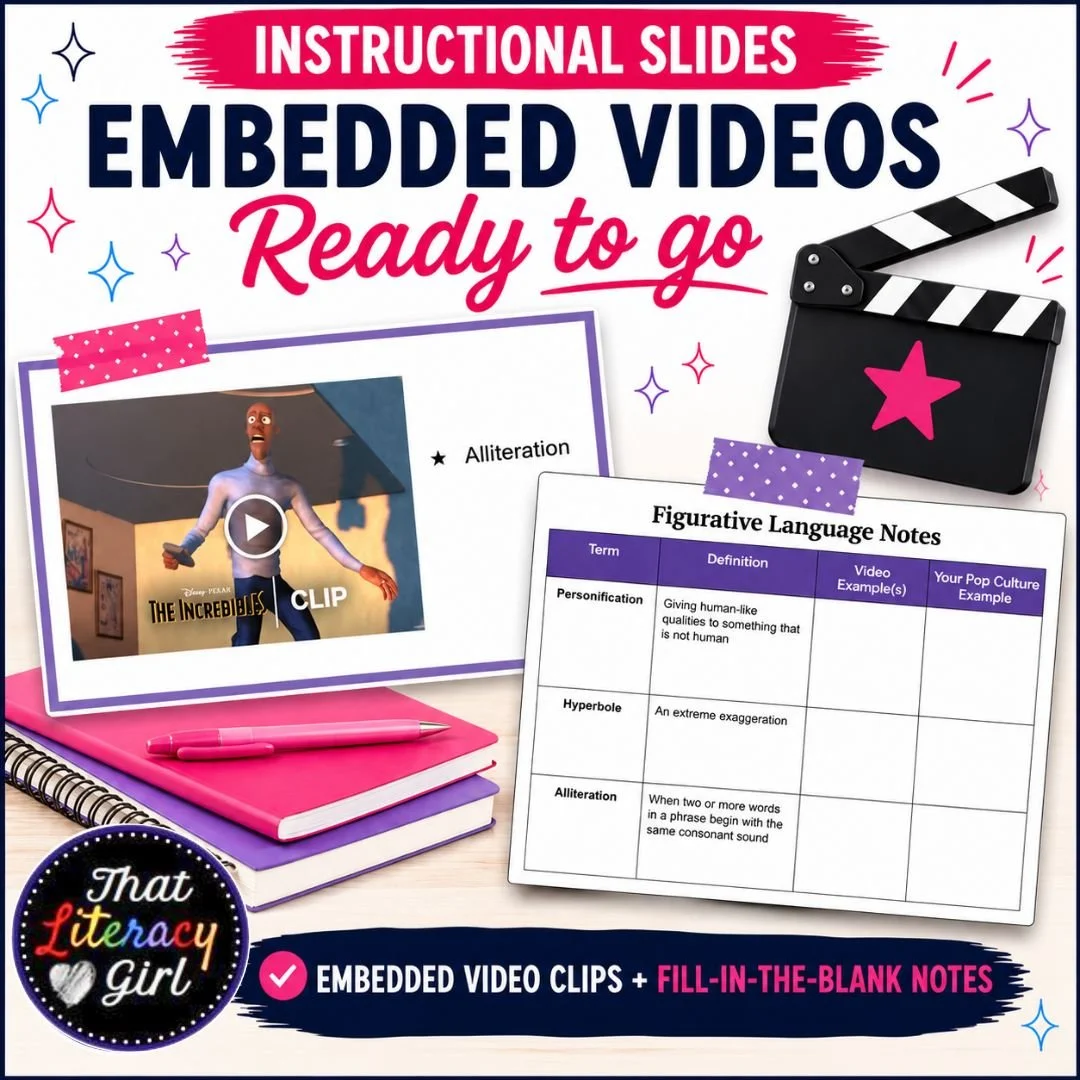
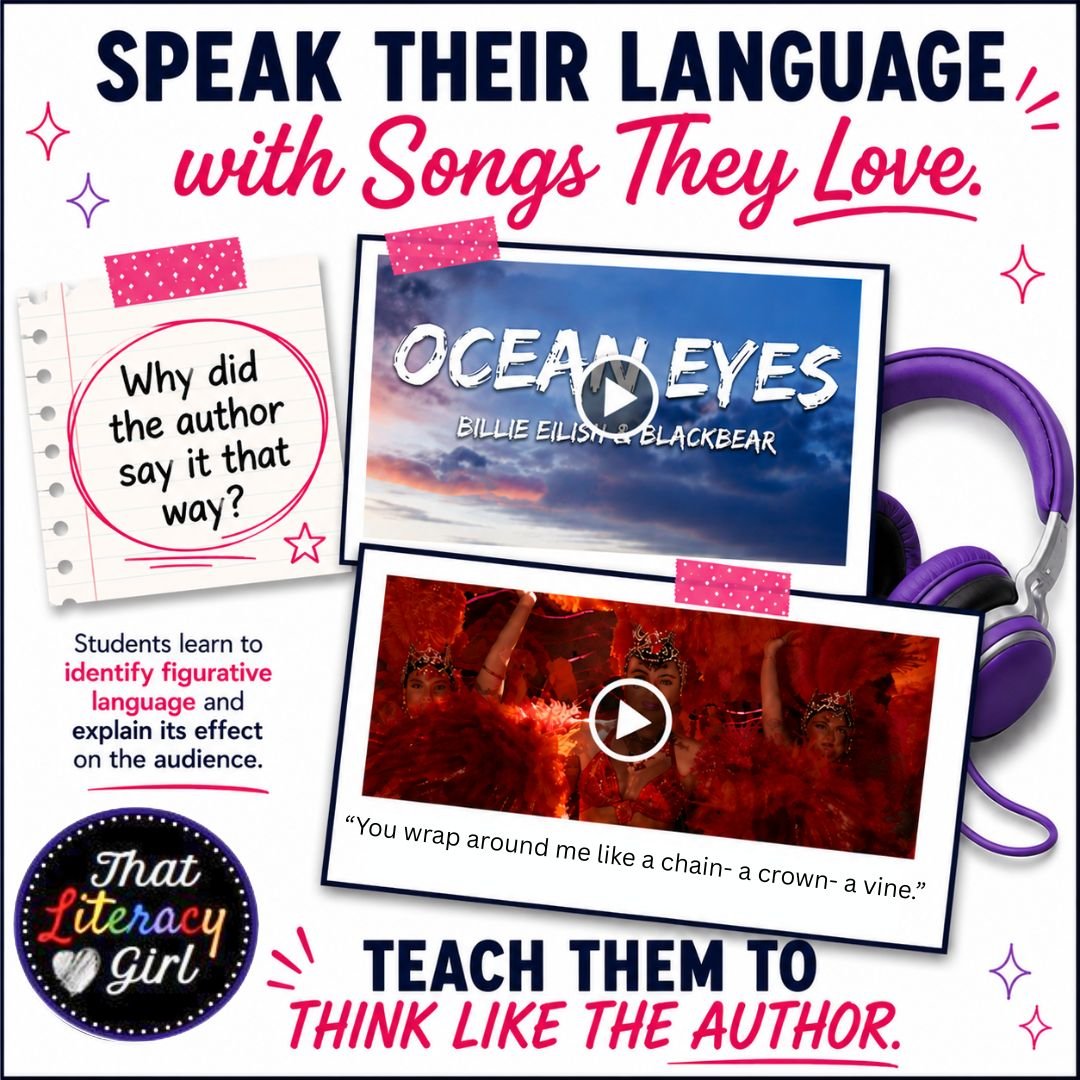
When introducing figurative language, I want students focused on the literary device—not trying to untangle a complicated plot.
That's why I created Introducing Figurative Language with Pop Culture, a slideshow that introduces each type of figurative language through familiar clips and lyrics while students complete a guided notes sheet. Together, we discuss each device, define it, and analyze examples in context before moving into a quick review where students identify the literary devices in additional lyrics and quotes. The notes page gives students a place to record definitions, examples from the lesson, and eventually examples they discover on their own.
By the end of the lesson, most students can correctly identify figurative language when I provide the examples.
That's a great start.
But again— that isn't the goal.
The real magic happens when students begin finding figurative language on their own.
Step 2: Transfer the Skills to Authentic Texts
Once students have a solid foundation, it's time to remove the training wheels.
Instead of giving them another list of pre-selected examples, I challenge them to find figurative language on their own while they're reading.
I often use texts we're already studying in class—stories rich in figurative language like All Summer in a Day (honestly—anything by my man Ray Bradbury is a great choice) or Moon Over Manifest by Clare Vanderpool.
As students read, they return to their Introducing Figurative Language with Pop Culture notes sheet. This time, they fill in the final column with examples they discover in the text instead of examples I provide. That final column was designed specifically for students to record their own pop culture or authentic reading examples.
Not reading a class novel?
No problem.
I'll often challenge students to find examples in their favorite songs instead (as long as they're school appropriate and aren't examples we've already discussed in class).
That third column isn't just another part of the worksheet.
It's evidence that students can now recognize figurative language without me pointing directly to it.
This is where figurative language starts to become a habit.
Step 3: Think Like An Author
At this point, I have students identify an example of figurative language from their notes and answer the following questions:
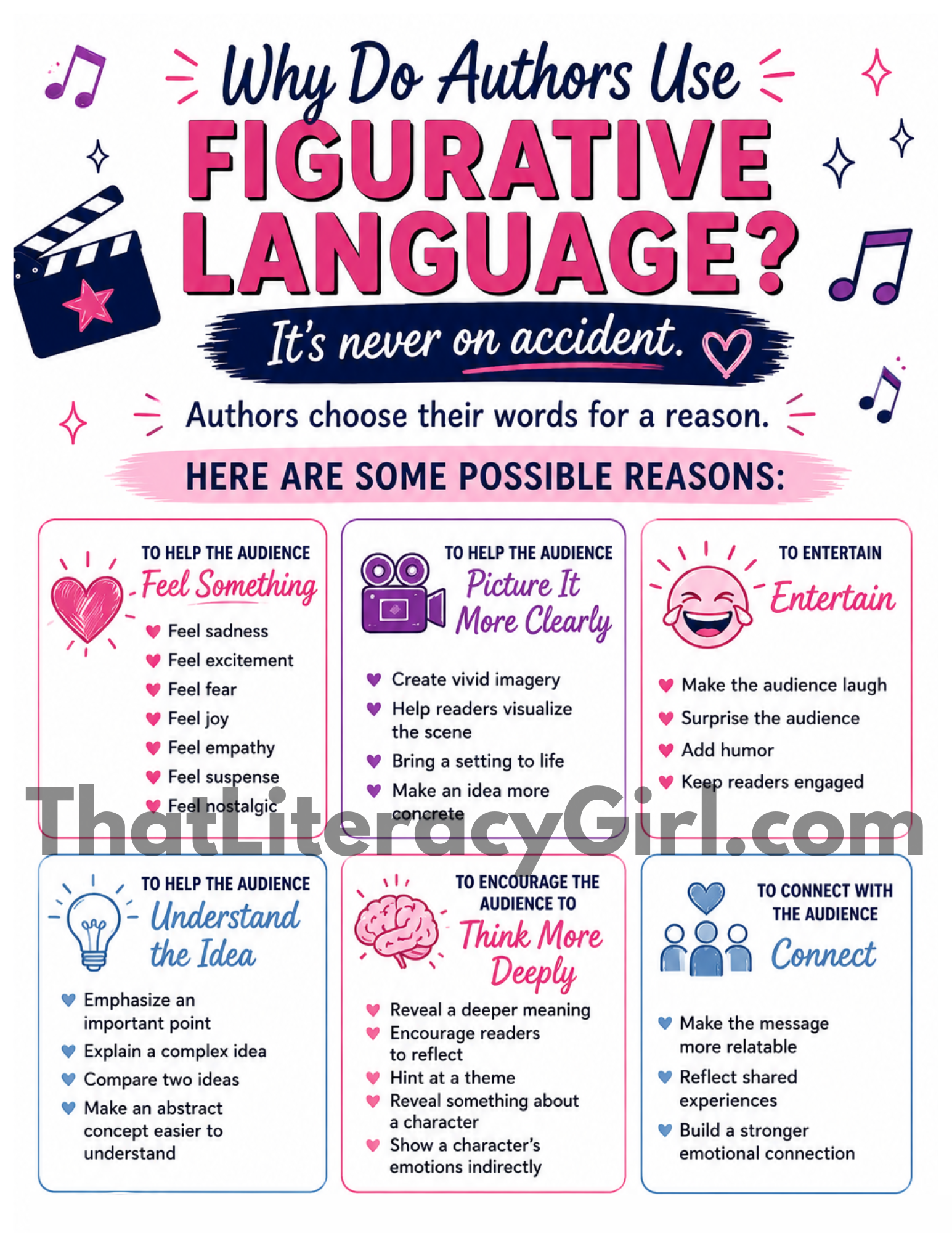
What effect does this have on the audience?
Why is this more powerful than saying it literally?
What was the author trying to accomplish?
Write a 5-7 sentence response that includes a claim, evidence, and reasoning.
You can download this part of the lesson for FREE as part of my Think Like An Author Figurative Language Toolkit!
1) It includes this Why do Authors Use Figurative Language? anchor chart to print for your wall or students’ notebooks
2) A fun creative writing challenge where students choose (or close their eyes and pick!) three prompts: a goal/purpose, a setting, and a literary device they’ll use to accomplish that goal— example: nostalgia, a dragon attack, personification.
3) A Think Like An Author Literary Analysis prompt with sentence starters and this image as inspiration to get started!
Step 4: Incentivize the hunt
Once students start finding figurative language on their own, I like to add a little friendly competition.
Like I said, students are required to find at least one example of every type of figurative language we're studying.
Then, for every additional example they discover, they earn a class raffle ticket.
It's amazing how quickly students transform into literary detectives.
They start noticing metaphors they would've skipped over.
They debate whether a phrase is an idiom or personification.
They proudly call me over to share the latest example they've found or to ask thoughtful questions.
WARNING: If you go this route, give students a deadline.
Whether it's by the end of today's assignment, for homework tonight, or by the end of the week, make sure there's a clear stopping point.
Otherwise, your students will spend the rest of the school year interrupting class to announce every simile, metaphor, and hyperbole they encounter.
As much as I love that enthusiasm...
...it's probably not the classroom management strategy you're going for. 😄
The goal isn't for students to spend every minute hunting for figurative language.
The goal is for them to begin noticing it naturally as they read.
Once that habit starts to develop, you've accomplished what you set out to do.
Step 5: Keep the Excitement Alive
Once students start noticing figurative language everywhere, I don't want that excitement to disappear after one lesson.
I want to keep feeding it.
One of my favorite ways to do that is through a review game I call Classroom Jukebox.

Students choose from one of three music-themed tracks—Disney, Taylor Swift, or Broadway (featuring songs from Wicked, Hamilton, and Matilda, The Musical)—and identify the figurative language hidden in featured song lyrics.
To make things even more fun, they can earn bonus points for correctly naming the song.
It sounds simple, but my students are obsessed.
They'll beg to play "just one more round."
They'll replay a track they already completed because they're determined to beat their high score, the class high score, or earn a perfect score.
Because what do they get if they earn a perfect score? You guessed it! Another raffle ticket— the things kids will do for Fun Dip, I tell ya!
And of course it’s not just about the fun and engagement—
They're reviewing figurative language over and over again without complaint.
And they’re doing it with texts that matter to them—their favorite songs!
The goal isn't simply to expose students to more examples.
It's to help them become so familiar with figurative language that recognizing it begins to feel automatic, personal, and fun.
When that happens, students don't just perform better on quizzes.
They become stronger, more active readers.
Want the Resources Featured in This Lesson?
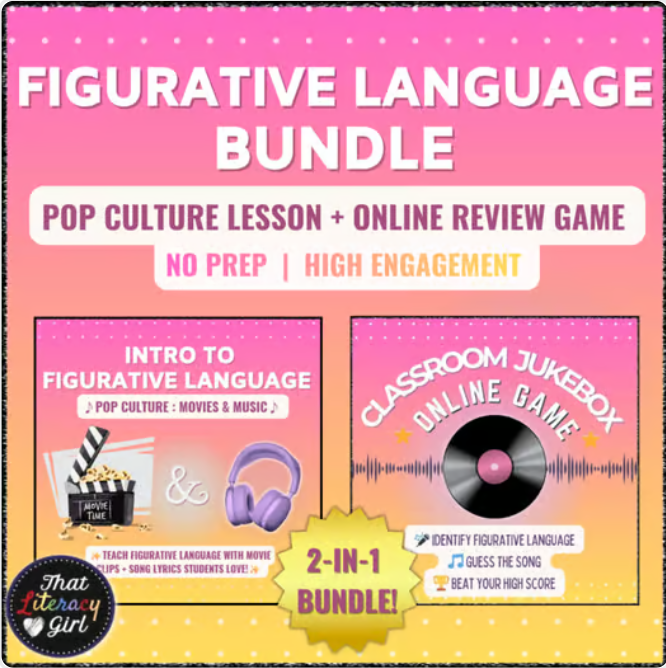
⭐ My Pop Culture Figurative Language Bundle includes all of the resources discussed in this blog for a discounted price. Each resource can also be purchased separately:
👉 Get my FREE Think Like an Author: Figurative Language Starter Kit
✔ Why do Authors Use Figurative Language? anchor chart
✔A fun creative writing challenge where students choose (or close their eyes and pick!) three prompts: a goal/purpose, a setting, and a literary device they’ll use to accomplish that goal— example: nostalgia, a dragon attack, personification.
✔ A scaffolded Think Like An Author Literary Analysis prompt
