5 Classic Horror Stories for Secondary ELA—and the Literary Elements I Teach With Each One

Have you ever noticed how horror has a way of ruining perfectly ordinary objects?
A sewer drain becomes Pennywise’s domain.
Buttons—Other Mother’s eyes.
A staticky television—a sign of Samara’s return.
Not one of these objects is dangerous, but after reading the right story or watching the right movie, they become wrong somehow. Uncomfortable.
I couldn’t sleep in a room with any TV for months—if not years—after watching The Ring when I was way too young.
Where were my parents? 🫣
Every October, I share that story with my gifted 8th graders and ask them to reflect on something unreasonable they once feared—or still do.
Students give answers like…
Shower curtains.
Puppets.
Dark hallways.
Every year, someone inevitably mentions scrambling up the stairs at top speed to outrun the encroaching boogeyman.
And then everyone feels seen and understood.
Heck—I’m a full-grown woman, and I still feel the urge to go full-on spider monkey up the stairs at night. 😂
The ability of horror writers to evoke such fear of ordinary objects is precisely what drives my Tales from the Dark unit.
Our essential question:
How do authors make the ordinary unsettling?
Through five classic tales, students discover that effective horror writing isn’t just about blood, gore, and jump scares.
It’s about carefully manipulating diction, syntax, point of view, repetition, pacing, foreshadowing, irony, and symbolism until readers begin questioning everything they once considered safe and familiar.
And throughout the unit, I want students thinking about those techniques as more than literary terms to identify.
They’re tools.
One Important Thing Before We Start…
Before we ever read the first story, students choose an ordinary object they might eventually make unsettling themselves. I make them draw blindly from an envelope.
A charm bracelet. A stuffed animal. A wig. A phone charger. You get the idea.
Then, as we study each new literary technique, students complete a short 300–500 word quick-write experimenting with that skill.
After The Hitchhiker, they try foreshadowing.
After Poe, they manipulate diction or syntax.
Later, they experiment with unreliable narrators, irony, and symbolism.
They don’t have to keep developing the same story idea each time. In fact, I encourage them not to feel married to anything.
Some experiments turn into pieces of their final stories.
Some lead absolutely nowhere.
That’s okay.
The point is to give students space to try a craft move before they need it to work.
So what do we read—and through what lens?
1. The Hitchhiker by Lucille Fletcher
Ordinary Made Unsettling: A hitchhiker. A road trip.
Craft Focus: Foreshadowing
Why Students Love It
Written in 1941, The Hitchhiker first debuted as a radio performance on the Orson Welles show, which makes it the perfect reader’s theater script.
Your middle schoolers are sure to giggle and cringe as Mrs. Adams kisses her son Ronald goodbye and later as Ronald’s female passenger takes off her shoes and announces, “My dogs are killing me!”
After all, that particular usage of “dogs” is right up there with “aura” and “demure” in middle school lexicon… they think they invented it, but Miss Fletcher’s radio show proves otherwise. 😂
And once the same ominous hitchhiker begins inexplicably appearing along Ronald’s cross-country road trip again and again, students are hooked.
Why I Teach It
I won’t spoil the twist ending for you, but I will say that the symbolism of the hitchhiker is fascinating.
Last year, my students covered our entire whiteboard with competing theories about what exactly happened in the story and what the hitchhiker was meant to convey.
Discussions like that—when students’ eyes are lighting up over the possibilities of literature—are why I do what I do.
But before we get there, The Hitchhiker gives us our first answer to our essential question:
Authors make the ordinary unsettling using foreshadowing.
We study the breadcrumbs Fletcher leaves throughout Ronald’s journey.
Which details seem insignificant at first?
Which ones take on new meaning once we know how the story ends?
How early did Fletcher actually begin telling us the truth?
And once students have watched Fletcher do it, foreshadowing becomes the first tool they get to try themselves.
2. The Tell-Tale Heart by Edgar Allan Poe
Ordinary Made Unsettling: An old man’s eye. A heartbeat.
Craft Focus: Diction & Syntax

Why Students Love It
It’s both twist-y and twist-ed.
What else can you ask for in a spooky story?
Why I Teach It
Of course this list wouldn’t be complete without the master of the macabre, our favorite mustachioed madman, Edgar Allan Poe.
But I don’t teach The Tell-Tale Heart simply because Poe is practically synonymous with spooky season.
This story contains some of my favorite examples of just how intentional writers are with language.
For example, Poe describes the thin strip of light that falls on the old man’s eye as “a single dim ray like the thread of a spider.”
When I first ask students why Poe references a spider’s thread instead of any old piece of string, I usually get responses along the lines of:
“Because spiders are creepy and the scene is about murder.”
Fair.
But then we push deeper.
What does a spider do with its web?
Who is the predator in this scene?
Who is trapped?
Suddenly, students aren’t simply identifying figurative language. They’re analyzing the narrator as a predator slowly closing in on his prey.
And that’s just one sentence.
Throughout the story, we examine Poe’s diction—why this word instead of another?—and his syntax—why does this sentence sound and move the way it does?
The Tell-Tale Heart is also the one story in this unit I typically play as an audiobook. There are some wonderfully spooky readings out there, and hearing the narrator’s voice makes his unraveling much harder to miss.
At first, he’s careful. Methodical. Even his repetition feels deliberate:
Cautiously—oh, so cautiously—cautiously.
He also spends a suspicious amount of time assuring us that he is definitely, absolutely, completely sane.
Which, as I like to point out, is generally not something sane people feel compelled to announce repeatedly.
As the narrator loses control, his sentences lose control too. His language becomes fragmented, frantic, disjointed.
It also gives me the opportunity to teach one extremely important fact about literary history:
Edgar Allan Poe was the OG em-dash king. NOT ChatGPT.
At this point, plenty of my eighth graders recognize the infamous AI em dash before they’ve ever really thought about what an em dash does.
Poe gives us the perfect excuse to talk about how punctuation shapes syntax, pacing, and voice—and how the patterns we now associate with AI existed in great writing long before ChatGPT entered the conversation.
By the end of the story, students aren’t just finding punctuation marks or sentence fragments.
They’re asking how Poe makes the narrator’s language unravel right along with him.
3. The Raven by Edgar Allan Poe
Ordinary Made Unsettling: A bird. A knock at the door. Curtains. Shadows.
Craft Focus: Repetition
Why Students Love It
Let me be clear:
I do not hand my eighth graders all 18 stanzas of The Raven and tell them to have at it.
I like them too much for that.
Instead, we zoom in on carefully selected portions and break the poem apart together.
At first, Poe might as well be writing in another language.
Surcease of sorrow?
Night’s Plutonian shore?
Nepenthe?
Balm in Gilead?
Cool cool cool.
But little by little, we crack it open.
👉 This annotated close-read version of the text helps a lot!
Students paraphrase what the narrator is actually saying, examine how ordinary objects become emotional triggers, and trace each appearance of “Nevermore.”
At one point, the narrator himself reaches the perfectly logical conclusion that the raven probably knows only one word, learned from some former owner.
And then he keeps asking it increasingly painful questions—about his grief, Lenore, and whether he’ll ever find relief—even though he already knows the raven has precisely one response.
By the end, students who could initially decipher only a line or two understand that the narrator is completely burdened by grief—and largely torturing himself.
Of course, they also make fun of him.
He’s basically doing the 19th-century version of doom-scrolling: rage-baiting himself with a bird. 😂
That’s one of my favorite things about teaching difficult texts—watching a poem go from “What on earth is this man talking about?” to something students understand well enough to belittle or belove.
Why I Teach It
The Raven gives us another answer to our essential question:
Sometimes authors make the ordinary unsettling by refusing to let us escape it.
A word.
A sound.
An idea.
Again.
And again.
And again.
We talk about how repetition changes meaning over time.
“Nevermore” isn’t inherently terrifying. But every repetition accumulates weight until one ordinary word carries the narrator’s grief, hopelessness, fear, and obsession.
And eventually, we have to ask:
Should we actually believe this guy?
Wait…Can We Trust Either of These Guys?
After The Tell-Tale Heart and The Raven, we put the two narrators side by side.
One repeatedly insists that he is perfectly sane while explaining how he murdered an old man because he didn’t like his eye.
The other understands that his raven probably has a one-word vocabulary and then proceeds to treat its responses as increasingly devastating prophecies.
Reliable sources, clearly.
Rather than stopping at an unreliable narrator is someone we can’t trust, students consider the bigger questions:
What is actually happening—and what does the narrator only believe is happening? How do grief, obsession, and paranoia distort what we see?
Enter: The Simpsons
Yes.
The Simpsons.
Its adaptation of The Raven gives us a surprisingly useful visual to separate literal reality from the narrator’s increasingly distorted perception.
Students compare Poe’s language with the visuals and analyze moments like dying embers transforming into ghostly hands or curtains becoming monstrous because of what the narrator feels rather than what is literally there.
One of my favorite moments comes near the end when Homer/the narrator is clinging to the bust of Pallas Athena—the goddess associated with wisdom and rational thought—while very clearly losing his grip on rational thought altogether.
Students analyze exactly that tension between logic and emotion.
👉 The Raven Unreliable Narrator Visual Analysis
Once they’ve analyzed both narrators, we settle the issue of credibility in the only reasonable way…
With a rap battle.
Obviously.
Students create a back-and-forth battle between one of our unreliable narrators and a voice calling him out—the raven, the old man, the police officers, or even the old man's heart. As the narrator grows increasingly defensive and unstable, students deliberately manipulate diction and syntax to show his deterioration.
One student, for example, began with a narrator confidently taunting the heart:
“Beat on little heart, it won’t make a difference.”
As the battle continues, the heart starts poking holes in his story, asking why someone so “sane” murdered a man over an eye.
By the end, the narrator is screaming, repeating himself, stuttering, and completely losing control of his sentences:
“What? But—but, I was so—so careful.”
In the reflection, the student explained that they intentionally made the narrator’s language more frantic while keeping the heart calm and controlled.
That’s the goal.
Not:
Find an example of syntax.
But:
Use syntax intentionally to make a character sound like he’s unraveling.
That’s a very different level of understanding.
4. Lamb to the Slaughter by Roald Dahl
Ordinary Made Unsettling: A leg of lamb. A quiet evening at home.
Craft Focus: Irony & Symbolism
Why Students Love It
Lamb to the Slaughter begins almost painfully ordinarily.
A wife waits for her husband to come home.
She gets him a drink.
They talk.
She starts thinking about dinner.
And then Roald Dahl takes that domestic scene and turns it completely on its head.
There’s the obvious middle-school appeal of, you know…
murder via frozen dinner.
But what I really love about this story is how much is happening beneath its deceptively simple surface.
Why I Teach It
In terms of reading difficulty, this is one of the more accessible texts in the unit.
And yet every year, students miss some pretty important details.
Mary is pregnant.
Patrick is planning to leave her.
Dahl never stops and announces either fact with a giant neon sign, which makes the story a great opportunity to talk about inference.
What did Dahl actually tell us?
What did he expect us to piece together?
And how does understanding those details change our feelings about what Mary does next?
Then we get to one of my favorite questions:
Who exactly is the “lamb” being led to the slaughter?
Is it Patrick?
Or is it Mary—the pregnant wife who begins the story devoted to her husband and completely unprepared for what he is about to tell her?
And then, of course, there’s the actual leg of lamb.
A lamb traditionally symbolizes innocence.
Yet this one becomes a murder weapon.
Mary herself appears every bit the sweet, innocent, devoted housewife.
Yet she is also a murderer.
The object and the character mirror one another: both look harmless. Neither is.
And that lets us move beyond simply identifying symbolism or dramatic irony to asking what those choices actually do. Dahl manipulates our assumptions about innocence and safety—right through the final scene, when the detectives unknowingly destroy the evidence themselves.
5. The Landlady by Roald Dahl
Ordinary Made Unsettling: A bed and breakfast. A cup of tea. A sweet old woman. Cute pets.
Craft Focus: Irony & Symbolism

👉 The Landlady Complete Reading Unit
Why Students Love It
Students catch on almost immediately that there is something off about the landlady.
Their first theory is frequently that her interest in seventeen-year-old Billy is… not exactly maternal.
Spoiler alert…
It’s worse.
As Billy settles into the bed and breakfast, students become increasingly suspicious.
Why is the room so cheap?
Why do those names in the guest book sound familiar?
Why are there no other guests?
Few things delight middle schoolers more than realizing they’ve figured something out before the protagonist has.
By the final pages, the general classroom energy is essentially:
BILLY. GET OUT OF THERE.
Why I Teach It
My favorite part of The Landlady actually comes after we finish reading it.
We go back.
Because on the first read, students know the landlady is creepy.
But they don’t yet know what they’re looking for.
On the second read?
Everything changes.
The sweet little pets that made the house feel homey?
Stuffed… like all her “little pets.”
The inexpensive room?
Not the unbelievable stroke of luck Billy thought it was.
The tea?
Maybe not such a lovely act of hospitality after all.
The cozy bed and breakfast?
A trap.
Now students see just how carefully Dahl has taken symbols of comfort and safety and twisted them into warnings.
That second read is where the story really earns its place in this unit.
Students realize the clues were always there.
They just didn’t know what they meant yet.
And that gets us right back to the question we started with:
How do authors make the ordinary unsettling?
Sometimes they don’t need to create something scary at all.
They just need to take something safe…
…and make us question whether it was ever safe in the first place.
Afterward, we also like to watch a short film adaptation and compare the choices made on-screen with Dahl’s original story.
And if you really want to commit to the bit, I’ve seen teachers transform their classrooms into cozy little bed-and-breakfasts, dress as sweet old landladies, and serve cookies and tea to set the scene.
As a Halloween queen in the classroom (who dressed as an old lady a few years ago and already has the costume), I can’t fathom why I haven’t done this yet.
But I respect those who have.
So…How Do Authors Make the Ordinary Unsettling?
At the beginning of the unit, students usually think they know what makes a story scary.
Murder.
Ghosts.
Blood.
Monsters.
By the end, their answers are much more interesting":
Foreshadowing: Give readers just enough information to sense that something is wrong.
Diction: Choose words that make an ordinary detail feel sinister.
Syntax: Control the rhythm and structure of language to manipulate pacing, emotion, and voice.
Repetition: Make a word, sound, object, or idea increasingly uncomfortable by refusing to let the reader escape it.
Point of view: Trap readers inside a perspective they aren’t entirely sure they can trust.
Irony: Give readers knowledge that changes how they interpret what characters say and do.
Symbolism: Take an ordinary object and make it carry something much bigger—and darker—than itself.
And throughout all of that reading, students have been writing.
Trying.
Abandoning.
Starting over.
Stealing pieces from their own earlier drafts.
Figuring out which techniques actually work for the story they want to tell.
By the time I finally ask them to write their own Tales from the Dark, they aren't opening a blank Google Doc and waiting for inspiration to strike. Some of those 300-word experiments become entire scenes. Others never see the light of day.
That's kind of the point.
They've had permission to try something before they need it to be good.
And year after year, the final spooky stories that come out of this unit are some of the best writing I've ever had students produce.
But that part deserves a post of its own someday!

Want to bring all these spooky stories into your classroom?
👉 Tales from the Dark Short Story Bundle
Want the stories and the writing experience?
👉Tales From the Dark Literary Analysis & Horror Writing Project
Completely Unnecessary but Highly Recommended Bonus Nonsense
As an Amazon Associate, I earn from qualifying purchases.
Oh—and throughout it all…
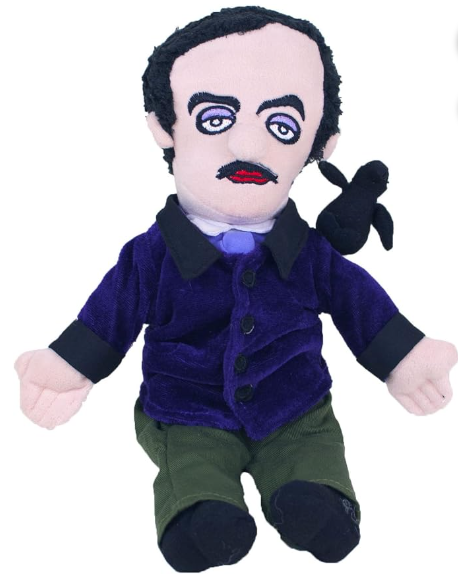
There’s also Poe on the Go!
My Edgar Allan Poe plush mysteriously moves around the classroom throughout October, à la Elf on the Shelf.
He brings a note each day filled with spooky vibes and a preview of what’s to come.
I insist that I have nothing to do with it…
Poe is out of control.
“But Mrs. Jeffery, Poe’s been dead for almost 200 years.”
We have agreed to disagree.
