Beyond the Halloween Fluff: 5 Meaningful Halloween Activities for Middle School ELA
I love Halloween.
I love the ghosty decor. I love the spooky stories. I love the creepy vibes, and I love leaning into my students’ crazy candied-up energy instead of shying away from it.
They are sugared up and distracted. That’s for sure.
But that doesn't mean we have to put actual learning on pause for the entire month of October.
There are approximately 47,000 Halloween worksheets floating around the internet involving candy corn, pumpkins, and completely random skills that have nothing to do with what students are actually learning.
And listen—sometimes a Halloween word search is exactly what everyone needs. 😂
But when I'm giving up actual class time, I usually want a little more bang for my buck.
Over the years, I've built up a collection of Halloween activities that let me lean ALL the way into spooky season without sacrificing the reading, writing, grammar, and critical thinking I want my students doing anyway.
Here are five of my favorites.
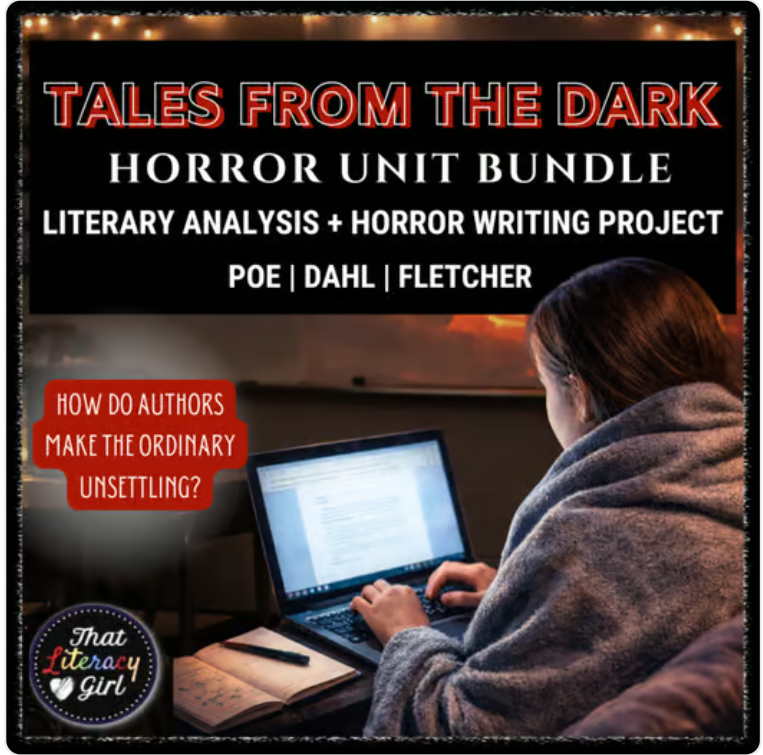
1. Turn October Into a Spooky Short Story Unit with Tales from the Dark
October is basically begging us to teach creepy literature.
And one of my favorite things about spooky stories is that they lend themselves SO well to the kind of analysis I want my middle schoolers doing anyway.
Suspense. Foreshadowing. Irony. Mood. Characterization. Theme. Symbolism.
That's the idea behind my Tales from the Dark unit. Rather than taking a break from literary analysis for Halloween, we use the season as an excuse to dive into some of the darker stories that middle schoolers genuinely enjoy reading.
And there's something about reading a creepy story in October that just hits different.
Dim the lights. Put something appropriately ominous on the board. Tell them you're reading something disturbing today.
Move a Poe plushie around the room like he’s an elf on the shelf.
You get the vibe.
And after we've spent time analyzing how authors create suspense, tension, and all those wonderfully spooky vibes, my students try it themselves.
They write their own 1,000-word spooky stories, intentionally borrowing the techniques we've been noticing in the stories we've read.
So by the time we're done, they haven't just identified suspense, foreshadowing, mood, and all the rest on a worksheet. They've had to figure out how writers actually create those effects—and then make them happen in their own writing.
And there’s nothing fluffy about that.
I also wrote more about the stories I use and how I teach them in this post: 5 Classic Horror Stories for Secondary ELA—and the Literary Elements I Teach With Each One
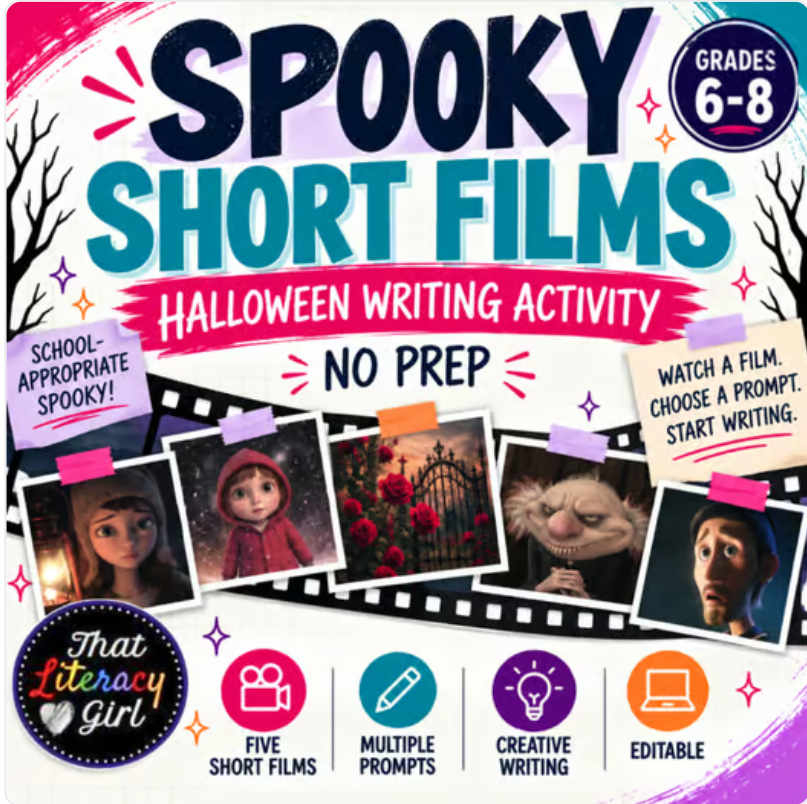
2. Use Spooky Short Films as Creative Writing Launchpads
One of my favorite ways to inspire creative writing is through short films.
My Spooky Short Films Creative Writing Activities use five eerie animated shorts as launchpads for students' own stories. After watching, students aren't given one prescribed thing to write. Instead, they have multiple ways into the story:
They might continue where the film ends.
They might tell the story from another character's perspective.
They might develop the backstory of a mysterious character or creature.
They might take one element from the film and move it into an entirely different setting.
The film gives everyone a shared starting point, but the writing can go in wildly different directions.
And if you don't want to devote an entire unit to it, try Fright Fridays. 👻
Watch one short film each Friday in October and let students choose which direction they want to take the story. It's an easy way to make Fridays feel a little different during spooky season without throwing your regular instruction out the window.
They're still developing characters, making purposeful plot decisions, experimenting with perspective, and figuring out how to keep a reader hooked—they just get a creepy little film to spark the ideas first.
3. Go Back to the Original Dark Fairy Tales
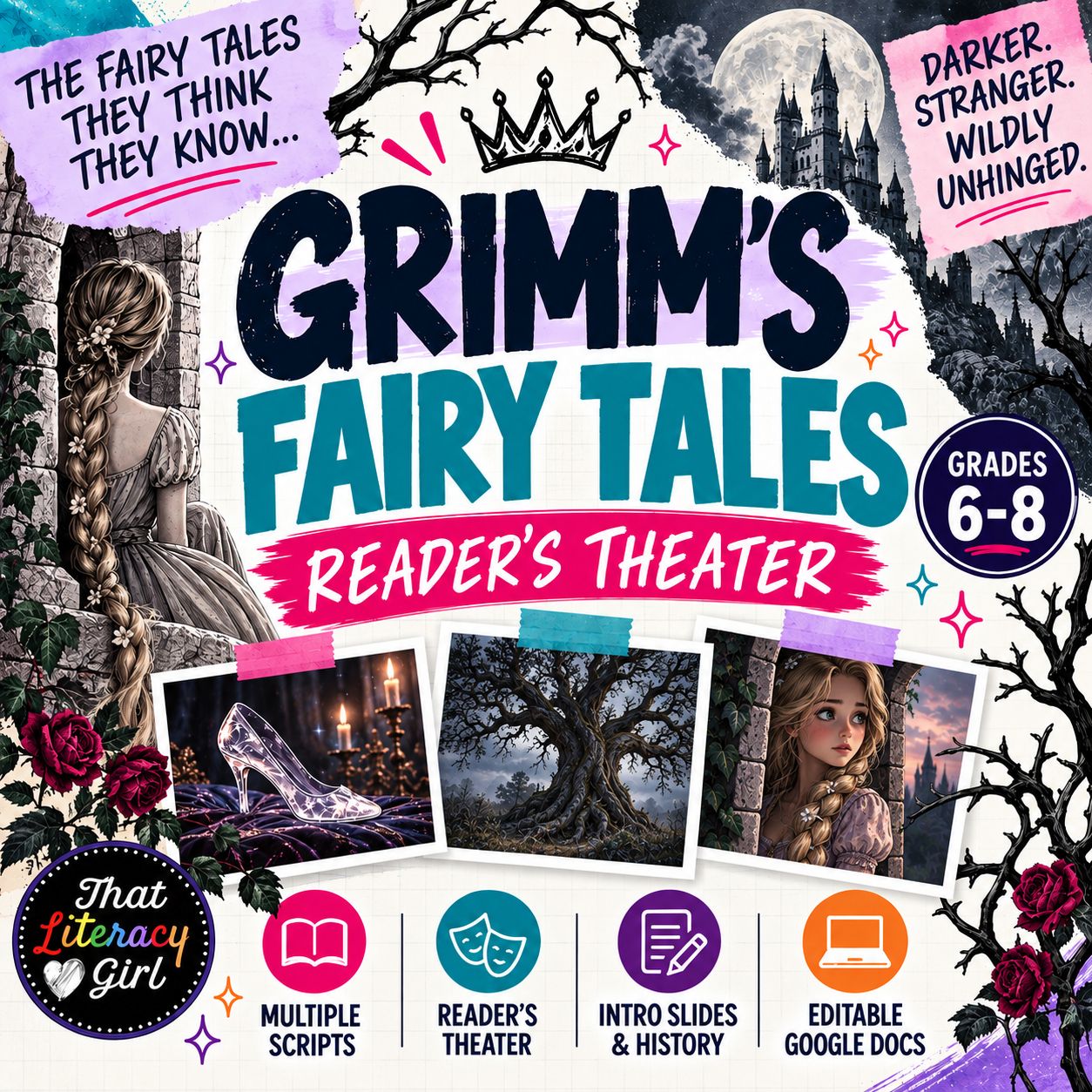
Middle schoolers think they know fairy tales…
But do they really?
The original Grimm fairy tales are darker, stranger, and often much more complicated than the versions students grew up watching—which makes them perfect for October.
My Grimm Fairy Tales Reader's Theaters bring some seriously twisted tales to life in my classroom every October!
Reader's theater gives students a reason to pay attention to character, dialogue, tone, and what's actually happening in the story. And because they're performing for one another, they’re laughing, bonding, and loving literature.
But underneath all that fun, they're also experiencing classic literature in a way that makes it accessible and memorable. They're reading closely enough to understand their character, listening to how a story unfolds, and seeing how the choices characters make drive the plot.
Plus, there’s something deeply satisfying about watching a room full of middle schoolers discover that the beloved Disney-fied fairy tales of their childhoods are actually wildly unhinged. 😂
4. Let Students Explore the Museum of Oddities
Sometimes the real world is weird enough. 😂
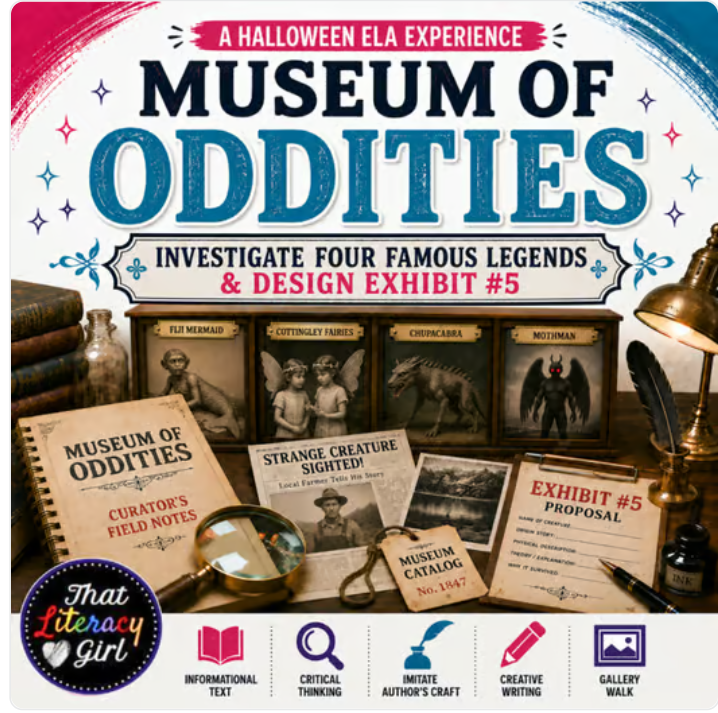
That's the idea behind my Museum of Oddities, where students investigate four famous mysteries: the Fiji Mermaid, Cottingley Fairies, Chupacabra, and Mothman.
But we're not just reading creepy nonfiction for the sake of reading creepy nonfiction.
As students investigate each oddity, they examine the evidence and explanations surrounding it and wrestle with a question that, though always relevant, is especially fitting for Halloween:
Why are people so fascinated by the unexplained—and why do some legends survive even after we have a perfectly reasonable explanation for them?
Next, comes my favorite part.
Students become the curators. 🏛️
Using the Museum of Oddities article as a mentor text, each student creates Exhibit #5: an entirely original cryptid or oddity complete with its own appearance, first sighting, eyewitnesses, scientific explanation, and—most importantly—the human emotion that keeps its legend alive.
Inventing a believable legend isn’t easy.
Students must consider sensory details, suspense, structure, evidence, explanation, and all the little writerly choices that make an invented story feel real.
Once the exhibits are finished, we transform the classroom into our own Museum of Oddities. Students tour one another's exhibits in a gallery walk and vote for Curator's Choice Awards like Most Imaginative Creature, Most Likely to Give You Nightmares, Best Sensory Details, and Most Museum-Worthy.
It's weird. It's creepy. It's creative.
It’s author’s craft and storytelling and world-building.
Not bad for a lesson about Mothman, eh?😂
5. Lock Them Inside Grammar Manor 👻
Ghosts and grammar— the Halloween combination you didn’t know your classroom needed.
Sorting concrete and abstract nouns into columns is groan-inducing. But sorting them into the proper cauldrons on a Chromebook? That's an escape room.
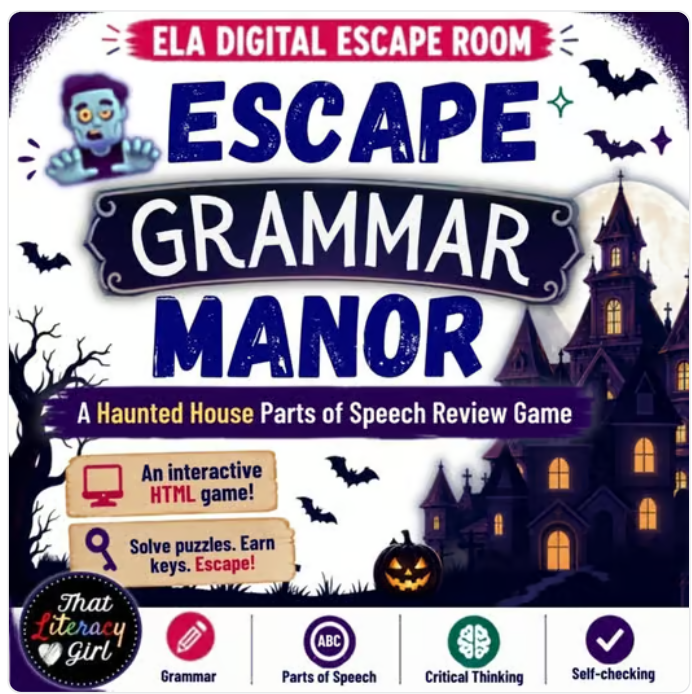
Escape Grammar Manor is a fully coded HTML game that turns parts-of-speech practice into an escape-room-style experience.
Students work with pronouns, nouns, verbs, adjectives, and adverbs as they make their way through the manor.
The Halloween element changes the experience, but the learning objective remains.
Students still need to know their grammar. They're still identifying and applying parts of speech.
But they’re so much more invested in proper pronoun usage when it will help them identify the shapeshifters hiding in the banquet hall.
Who knew all grammar instruction needed to be more engaging was a little impending doom?
Halloween Can Be Fun and Meaningful
I don't think every minute of October needs to be academically rigorous.
Sometimes we can just do silly Halloween things.
But I also don't think celebrating Halloween means we need to abandon everything we're already trying to accomplish in ELA.
The sweet spot for me is when the Halloween fun becomes part of the learning experience instead of replacing it.
Read something creepy.
Write something unsettling.
Perform something bizarre.
Investigate something weird.
Escape a haunted house by identifying an adverb. 😂
Whatever works.
Middle schoolers are already stoked about October.
We might as well use that to our advantage.
Happy spooky season! 👻
🎃 Want to Bring Some of These Ideas Into Your Classroom?
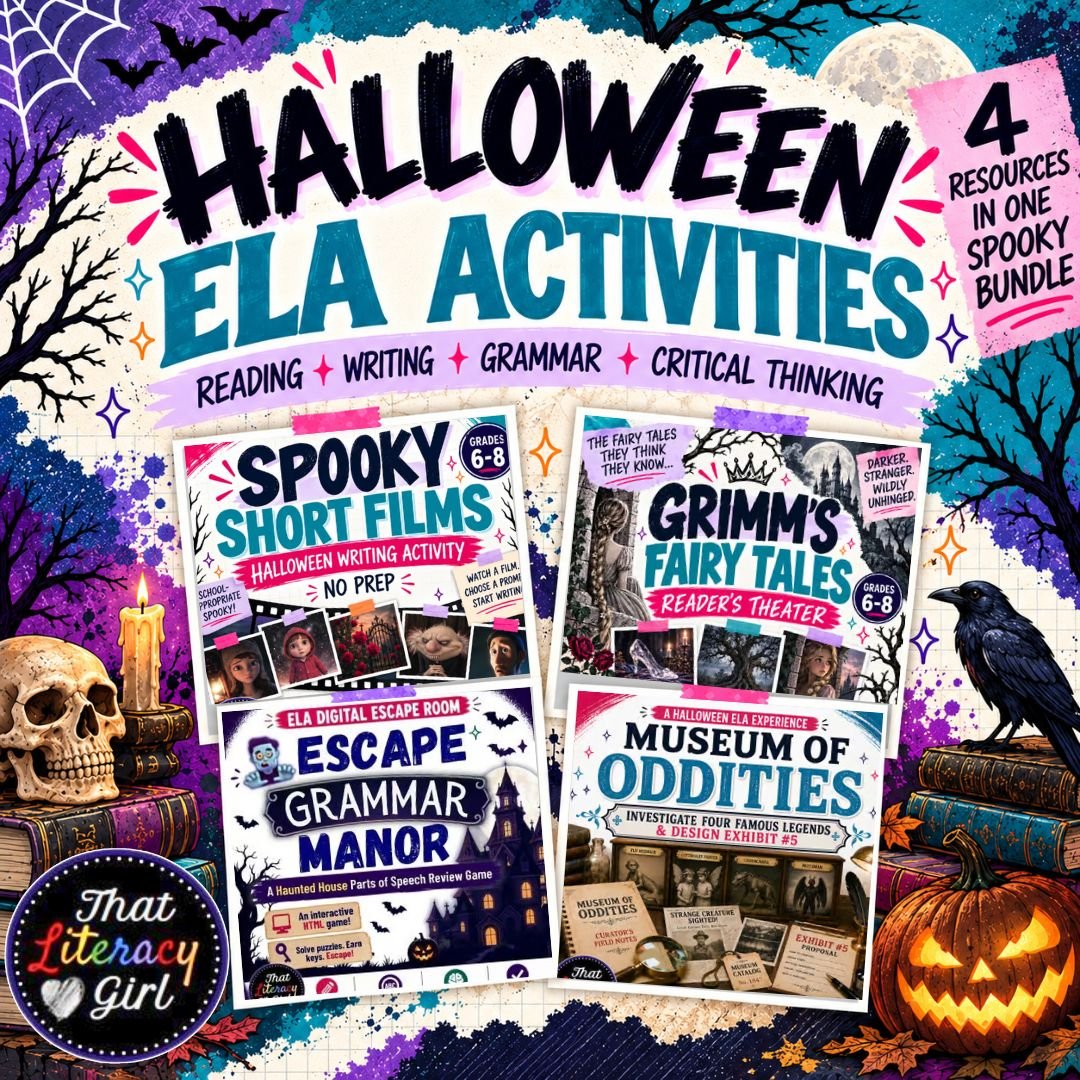
If you want to sprinkle some spooky season into the ELA curriculum you're already teaching, I've bundled four of these activities together in my Middle School Halloween ELA Activities Bundle.
You'll get:
🎬 Spooky Short Films — creative writing inspired by five eerie animated films
🏰 Grimm Fairy Tales Reader's Theater — Cinderella, Rapunzel, and The Juniper Tree
👻 Escape Grammar Manor — interactive parts-of-speech review in a haunted house
🏛️ Museum of Oddities — informational reading, critical thinking, and an original cryptid writing project
Buying the bundle saves you 20% compared with purchasing the resources separately.
Already own one of the resources? You can also grab each activity individually using the links throughout this post.
🕯️ Want to Go All-In on Spooky Literature Instead?
If you'd rather make spooky literature the curriculum instead of adding Halloween activities around what you're already teaching, check out my Tales from the Dark unit.
Students analyze creepy short stories for suspense, foreshadowing, irony, mood, symbolism, unreliable narration, and author's craft before applying those techniques to their own 1,000-word horror stories.