Replace Research Projects with Investigations
🔎 If your students love solving puzzles, they'll love these mystery-themed cryptograms. They'll practice pattern recognition and problem-solving while uncovering the hidden names of cryptids, famous crimes, and methods of clue collection. I use them as Think Outside the Box Thursday bell ringers or as extension activities for those students who always finish first and ask, "What can I do now?"
Students Are Already Investigators
I saw a sign at the store the other day that said:
"I'm not a stalker. I'm investigating."
Relatable.
Who hasn't turned into a social media detective when some drama is going down?
It reminded me immediately of my middle schoolers. Though these days their detective work probably takes place on Snapchat and TikTok rather than Facebook, which is my typical stalking grounds.
Regardless, if there's a social mystery to solve, they'll spend hours gathering evidence.
Who unfollowed who?
Who liked whose post?
What happened between those two friends?
Who started the rumor?
Kids can become remarkably dedicated investigators when they're motivated by curiosity.
Which raises an interesting question...
If students are naturally curious investigators, why don't they thrive on the research projects we assign them?
Because curiosity can't be assigned.
Most research projects ask students to collect information.
But they rarely give students a mystery worth solving.
Instead of investigating something they're genuinely desperate to understand, students end up summarizing facts about a topic they were assigned—or reluctantly selected from a list.
It's research...
But it doesn't feel like investigation.
That's why I completely reimagined my research unit.
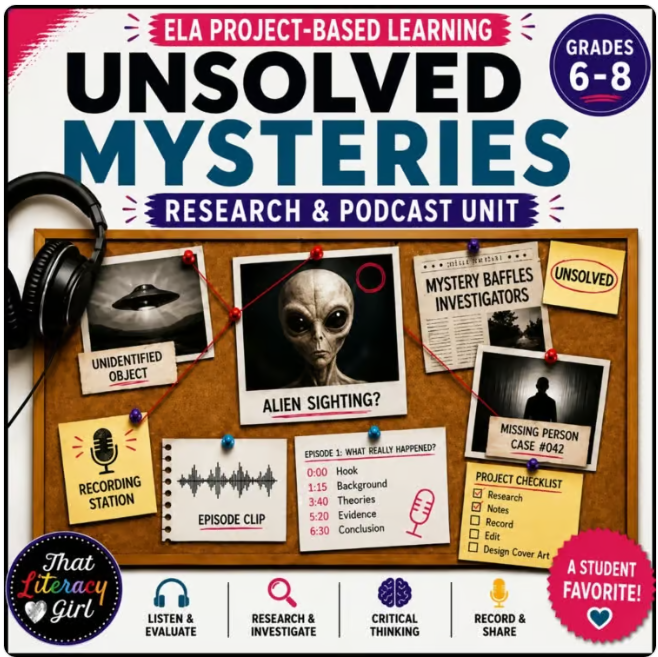
Instead of writing another traditional research paper, my students become investigative podcasters.
We Start by Becoming Detectives
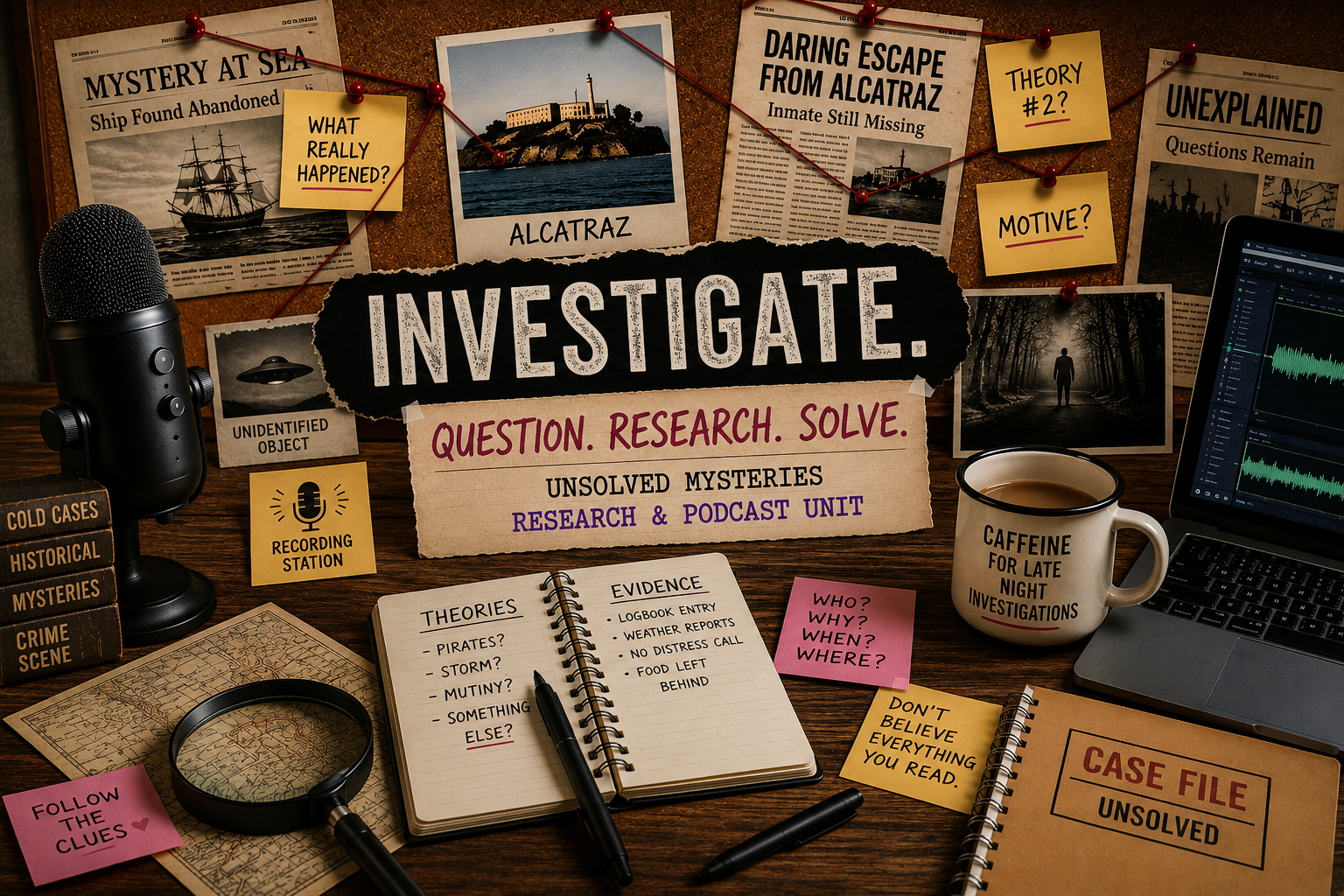
Before students ever choose a topic, I immerse them in two real unsolved mysteries through professionally produced podcasts about the disappearance of the Mary Celeste and the 1962 escape from Alcatraz.
The room comes alive almost immediately.
Some students become convinced one theory explains everything.
Others argue just as passionately for a completely different explanation.
They interrupt each other to point out overlooked evidence.
They question the credibility of certain claims.
They debate what really happened.
Without realizing it, they're already practicing the exact thinking skills I want them to use during research.
They're evaluating evidence.
Considering multiple perspectives.
Building arguments.
Changing their minds when new information emerges.
That's the kind of conversation every teacher hopes for.
Then They Choose a Mystery They Actually Want to Solve
Once students experience what authentic investigation feels like, they choose an unsolved mystery that genuinely fascinates them.
I provide a curated list of ideas to get them started, but students are also welcome to propose mysteries of their own.
Before committing, they first determine whether enough reliable information actually exists to investigate the topic thoroughly.
No— you cannot produce a whole podcast about Slenderman and cite five Reddit threads.
From there, they begin gathering evidence, organizing their research, and piecing together competing theories.
By the end of the project, students have created something far more meaningful than a research paper.
They've created an investigation.
More Than a Podcast
Students can work independently or with partners, which creates some of my favorite conversations of the entire unit.
How do you bounce ideas off one another and banter authentically without distracting from the point?
How do you make listeners laugh without getting off-topic?
How do you sound conversational while still being credible?
Those are authentic questions that real podcasters have to wrestle with.
My students quickly discover there's an art to balancing personality with professionalism.
As students begin recording, something else happens.
Many decide that audio alone isn't enough.
They start adding historical photographs, maps, newspaper articles, timelines, sound effects, music, and visuals until their final products feel less like classroom podcasts and more like Netflix documentaries.
Nobody tells them to do that.
They simply become invested enough that they want to make their podcasts even better.
The Moment I'll Never Forget
One of my favorite moments happened last year.
A seventh grader became so invested in the mystery she had chosen that she reached out to an author who had written a book connected to her case.
She had questions about the author's research and wanted to hear more about a particular theory.
To her surprise...
The author agreed to a phone interview.
That wasn't part of the assignment.
I never suggested students contact experts at all.
She simply became so curious that she wanted to learn from someone who had spent years researching the mystery herself.
That’s what authentic learning looks like.
When students voluntarily seek out more information because they genuinely care, we've moved beyond completing an assignment.
They're learning because they want to know the answer.
In fact, this particular student even went on to make multiple episodes of her true crime podcast and published it on Spotify with her parents' help and permission. She made something real because she was invested.
We End With a Podcast Party
At the end of the unit, we push the desks aside, spread out with flexible seating, grab popcorn and snacks, and host our annual Podcast Party.
Middle schoolers hate listening to their own voices. Who doesn’t? So they often ask for noise-cancelling headphones or to hide in the hallway while theirs is being played.
But after each podcast, every student shares something the creators did well.
They compliment each other's storytelling.
Their research.
Their editing.
Their humor.
Their speaking.
Their creativity.
Students who spent weeks worrying that their podcast wasn't good enough suddenly hear a room full of peers pointing out everything they did right.
It's one of my favorite days of the school year.
Research Worth Caring About
I don't think students dislike research.
I think they dislike researching topics that don't matter to them.
Give students a mystery worth solving, and suddenly they'll analyze evidence, question sources, debate competing theories, revise their thinking, and spend hours trying to figure out what really happened to produce something great.
Not because they want an A.
Because they're genuinely curious.
Turns out, our students were investigators all along.
And I don’t know about you… but I’d much rather have my students stalking decades-old mysteries than each other.
Ready to Turn Your Students into Investigative Podcasters?
If you're looking for a research project that feels more like solving a mystery than completing another paper, my Unsolved Mysteries Podcast Project walks students through the entire process—from selecting a compelling case and conducting research to scripting, recording, creating cover art, and sharing an original podcast.
That’s not just any project— that’s a meaningful experience.