How to Teach Students to Think Like Lawyers: 3 Pre-Mock Trial Experiences
✨Are you preparing your students for mock trial? Grab my FREE Mock Trial Starter Kit to save yourself time, money, and stress and get everything I wish I’d had before my first mock trial!
One of the biggest mistakes I see teachers make when introducing mock trial in the classroom is jumping straight into courtroom procedures and case preparation before students have had opportunities to develop the critical thinking skills that make mock trial successful.
Yes, students need to know what hearsay is and how a trial works. But if they haven’t practiced evaluating evidence, considering multiple perspectives, and defending their reasoning, courtroom procedures become little more than vocabulary words to memorize.
Before students can question witnesses, raise objections, or deliver closing arguments, they need to learn how lawyers think.
In my classroom, I intentionally build those skills throughout the year in a variety of ways. However, when mock trial season rolls around, there are three key experiences I rely on to help students develop the habits of mind they’ll need to be successful in the courtroom:
STEP ONE: Learn to Build Arguments
👉Courtroom Connections: Debate Game
One of the first things students discover during mock trial is that attorneys aren’t always arguing the side they personally agree with. Their job isn’t to argue what they believe. Their job is to build the strongest argument possible from the position they’ve been assigned. That’s why I begin with a simple, low-stakes debate game called Courtroom Connections. On the surface, the game feels silly— and it absolutely is.
Students are asked to argue connections between completely unrelated ideas. But in doing so, they’re practicing many of the skills attorneys use every day.
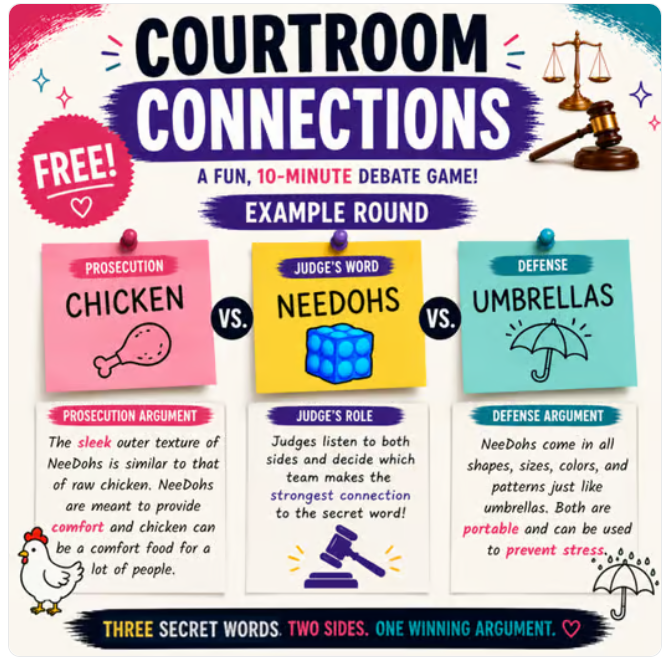
Here’s how it works:
The judge then listens to both sides and determines a winner based on the quality of the reasoning presented.
Watching the buzz this creates in my classroom is everything.
Immediately after the words are revealed, whiteboard markers squeak.
Students whisper frantically.
A timer beeps.
The time to prepare is over.
“Prosecution, please take the stand,” I announce.
A brave student emerges from their team’s huddle, whiteboard in hand, ready to make their case.
She clears her throat. “Your honor, today the prosecution and I will prove that chickens are more closely related to Needohs than umbrellas are.”
A student judge nods, pencil poised, ready to take notes and assess the evidence presented.
“First of all, Needohs are stress-relievers that provide comfort in difficult situations while chicken is a comfort food for a lot of people.”
The timer on the board flashes.
30 seconds left.
No time to waste.
She hands the whiteboard to another eager student.
“Needohs are also similar to a chicken’s egg as they have a sleek outer shell and a gooey interior.”
The timer beeps.
“Defense, please take the stand.”
While the arguments are often ridiculous, the thinking is clever and creative.
Students learn to support claims with evidence, anticipate counterarguments, collaborate with teammates, and defend positions they may not personally agree with. Those are the same habits of mind they’ll need later when they’re arguing a mock trial case.
And the best part?
Students don’t view it as practice at all. They just want to win the game. In fact, they ask to play whenever we finish class a few minutes early. Because it’s memorable, competitive, and fun.
STEP TWO: Learn to Evaluate Evidence
👉Legal Reasoning Stations
Once students are comfortable building arguments, I want them to grapple with a reality every lawyer eventually learns:
The facts are rarely as clear-cut as they first appear.
In the movies, legal cases are often presented as obvious. One side is clearly right. The other side is clearly wrong.
Real life is messier than that.
Attorneys must investigate evidence, consider competing perspectives, identify weaknesses in an argument, and make decisions even when the answers aren’t perfectly clear. Those are difficult skills to develop, especially for middle school students.
So before we ever begin preparing a mock trial case, I give students opportunities to practice those skills in a low-stakes, highly engaging environment.
Enter my Famous Court Cases stations:
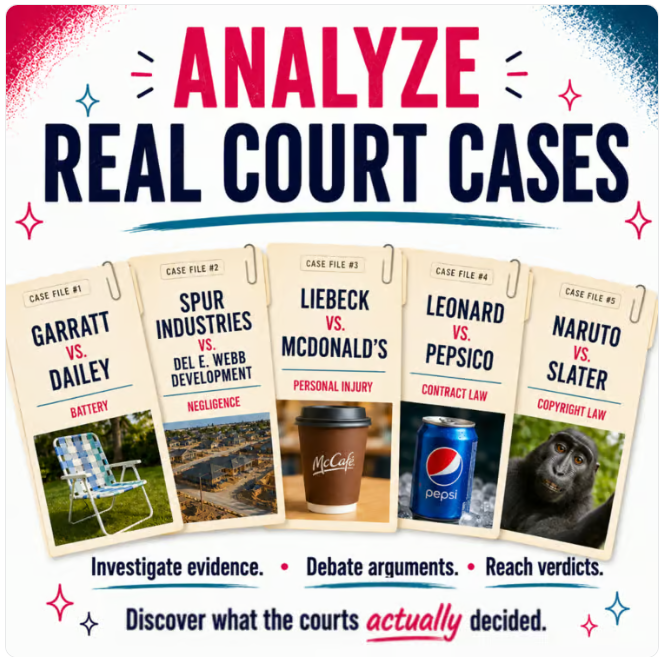
Leonard vs. PepsiCo
At one station, students scan a QR code to watch a Pepsi commercial. They laugh as a teenager lands a Harrier jet in the school parking lot. The screen reads:
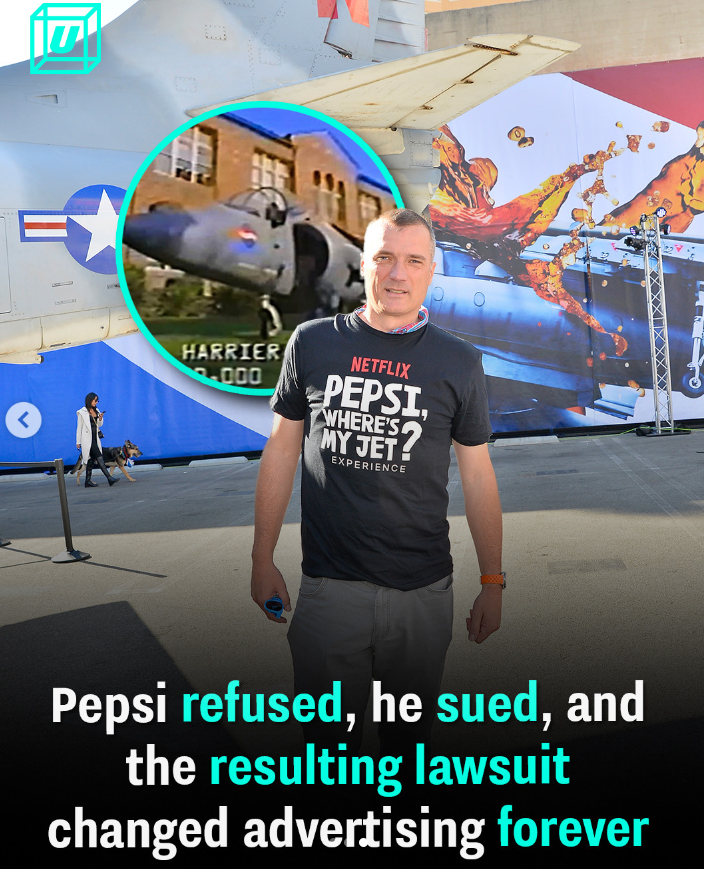
Harrier Fighter, 7,000,000 Pepsi Points.
“How could anyone believe this was a real offer?” one seventh grader insists.
“Wait. Zoom in. Is that a disclaimer at the bottom?”
“No. This evidence slip says they originally aired the commercial without one.”
“Oh…”
Suddenly the case doesn’t seem quite so obvious.
Leibeck vs McDonalds
At another station a student passionately argues that Stella Leibeck is responsible for the third degree burns she received from McDonald’s coffee.
“Why didn’t she ask them to add the cream and sugar for her?”
“Do you think she had Parkinson’s or tremors and that’s why she spilled?”
Another student immediately points out that the coffee was served between 180 and 190 degrees Fahrenheit and that McDonald’s had received hundreds of prior burn complaints.
“But McDonald’s gets millions of coffee orders per year. That’s nothing!”
Just like that, students are weighing competing evidence rather than jumping to conclusions.
But the station that always ends in passionate protest is Naruto v. Slater.

Naruto vs Slater
Filed by PETA on behalf of a macaque monkey in 2008, the case asks students to consider an unusual question:
If a monkey uses a photographer’s camera to take a selfie, who owns the copyright to that image?
The photographer? The monkey? No one?
According to the court’s final ruling, animals cannot own copyright.
According to my students—who pump their fists in the air and leave class shouting “Justice for Naruto!”—the issue is far from settled.
That’s exactly why I love these stations.
Students aren’t simply learning about five famous court cases.
They’re practicing the skills attorneys use every day.
By the time students receive their mock trial case packet, they’ve already learned that legal questions are rarely black and white, the legal system is complex and imperfect, and reasonable people can disagree about what truly qualifies as justice.
In other words, they’re no longer looking for the “right answer.”
They’re learning to think like lawyers.
STEP THREE: Experience The Justice System
👉Mock Trial Reader’s Theater: Ball vs PepsiCo
By this point, students know how to build arguments and evaluate evidence.
However, they still haven’t experienced how those skills interact within the structure of a trial.
They understand what an objection is (we go over that).
They may recognize a weak argument from a strong one.
They may even have strong opinions about what makes an effective or ineffective attorney.
But they haven’t yet seen how lawyers, witnesses, judges, and jurors work together to move a case toward a verdict.
That’s where reader’s theater comes in.
Pepsi, What’s in My Dew? is an original Reader’s Theater script I developed based on the 2009 case Ball v. PepsiCo, Inc.
In the case, a man claims to have found a dead mouse in a can of Mountain Dew purchased from a vending machine.
But did that really happen? And should Pepsi be held responsible?
The case is bizarre, funny, and just shocking enough to immediately hook students.
More importantly, it gives them an opportunity to watch a trial unfold from opening statements to closing arguments without the pressure of preparing a full case themselves.
Students take on the roles of attorneys, witnesses, judges, and jurors as the trial unfolds.
Throughout the trial, checkpoints marked with asterisks prompt students to pause and evaluate the credibility of witnesses, assess the strength of each attorney’s arguments, and consider where the preponderance of evidence currently lies.
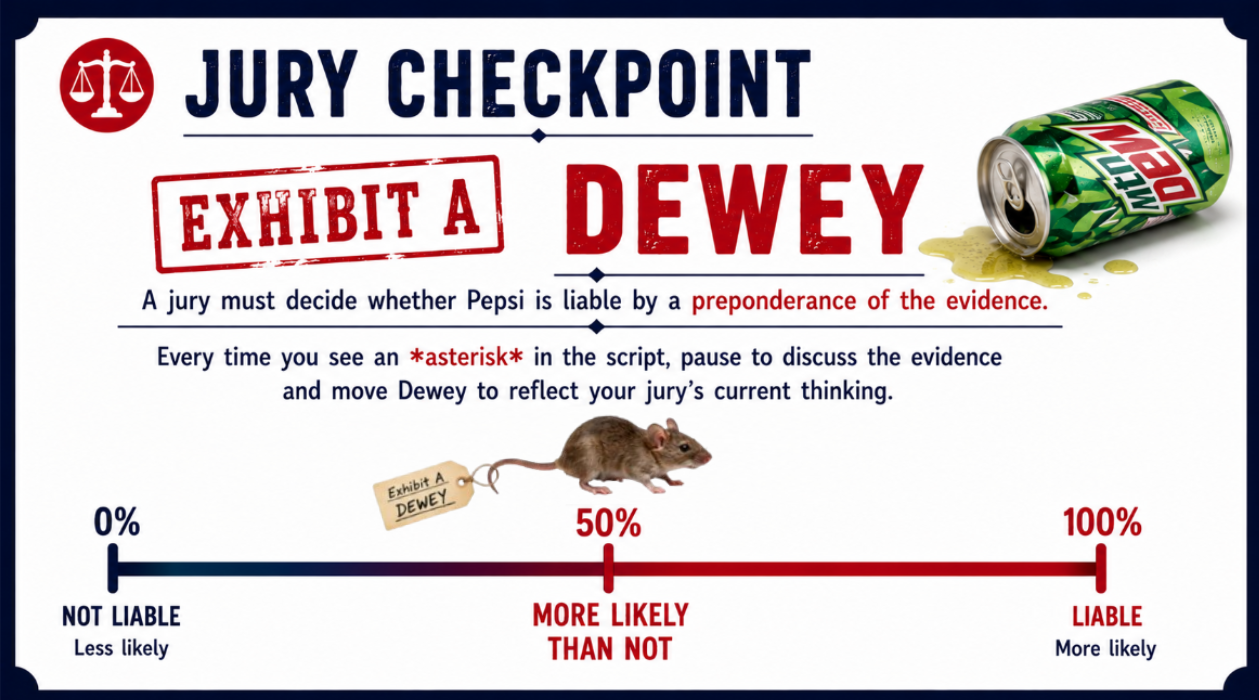
Students move Dewey (the Mountain Dew mouse 😅) on a sliding scale to represent the class’s current standing— is Pepsi liable?
Suddenly, the skills we’ve been practicing all along matter:
Evidence matters.
Sufficiently explaining the relevance of that evidence matters.
Effectively questioning, objecting, and presenting your case clearly all matter.
For many students, this is the moment mock trial finally clicks.
Students begin to see that a trial isn’t simply a collection of courtroom procedures—it’s a system designed to help people evaluate competing claims, reach informed decisions, and carry out justice to the best of their ability.
By the time students receive their actual mock trial case packet, they’ve already practiced building arguments, evaluating evidence, and observing how those skills operate within the framework of a trial.
The focus is no longer on simply memorizing courtroom vocabulary. They’ve worked with it intimately—they’ve experienced it.
Now, they’re free to focus on the higher-level thinking that separates good student attorneys from great ones: analyzing evidence from multiple perspectives, anticipating counterarguments, identifying weaknesses in a case, and strategically positioning evidence to support their claims.
In other words, they’re no longer learning how a trial works.
They’re learning how to think like lawyers.
✨Ready to Run Mock Trial in Your Classroom?
If you’re planning a mock trial and looking for the organizational tools, handbooks, templates, and implementation tips I use with my own students, grab my free Mock Trial Starter Kit!
Inside you’ll find:
✔ Code of Ethics: Student Professionalism Contract
✔ Defense & Prosecution Team’s Collaborative Document: Evidence tracker, Opening and closing statement templates, tips for building a timeline
✔ Judges’ Collaborative Document: Pretrial motion organization and objection predictions
✔ Attorney handbook: Tips for impeachment, refreshing memory, introducing evidence, cross-examination, and controlling the witness
✔ Witness handbook: Tips for responding on direct and cross, tips for
✔ Judge handbook: Tips for controlling the courtroom and ruling on objections
✔ Editable Mock Trial Script: Can be used with any case
✔ Objection cheat sheet
✔ Objection cheat sheet—Judge’s edition: Includes tips for how to rule on objections
✔ Jury summons letter: How I invite former students to participate in the jury
✔ Jury Instructions
✔ Recommended Mock Trial Cases
✔ Recommended Preparation Sequence for New Mock Trial Teachers
