5 High-Interest Court Cases That Will Get Your Students Talking
✨Are you preparing your students for mock trial? Grab my FREE Mock Trial Starter Kit to save yourself time, money, and stress and get everything I wish I’d had before my first mock trial!
One of the biggest challenges when introducing legal reasoning, argumentation, or mock trial is finding cases that students genuinely care about.
The good news? Real court cases are often far stranger than anything we could invent.
Over the years, I've discovered that some cases consistently spark debate, inspire critical thinking, and leave students arguing long after class ends. The best ones force students to wrestle with difficult questions, consider multiple perspectives, and realize that the law is rarely as straightforward as it first appears.
Here are five of my favorites.
These are the same cases I use in my Famous Court Cases Legal Reasoning Stations, one of my favorite ways to introduce legal reasoning before mock trial.
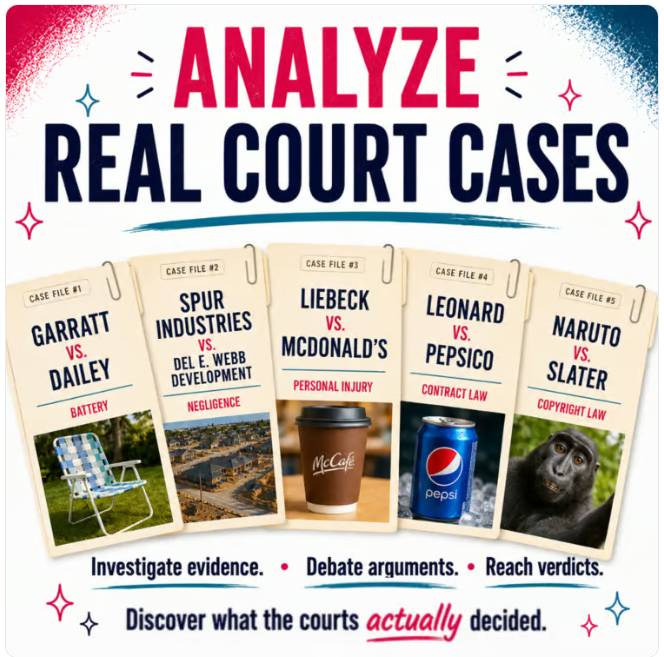
1. Liebeck v. McDonald's
The Question: Should McDonald's have been responsible when Stella Liebeck suffered third-degree burns after spilling hot coffee on herself?
If your birth year begins with a 19— congratulations! You’re ancient!— or “unc” as the cool kids say. More importantly, you’re probably very familiar with this case.
Growing up, I remember hearing adults shaming Stella Liebeck for suing McDonald’s…
Over hot coffee? Really!?
Most students enter this case feeling the same way.
"She spilled it herself."
"How is that McDonald's fault?"
Case closed, right?
Wrong.
When they learn that the coffee was served between 180 and 190 degrees Fahrenheit and discover that McDonald's had received hundreds of prior burn complaints before Liebeck's injury, suddenly, students begin reconsidering their initial assumptions.
Within minutes, students realize this isn't just a story about spilled coffee. It's a discussion about responsibility, negligence, consumer safety, and corporate accountability.
I LOVE using this case to discuss the power of the court of public opinion and the importance of knowing the facts before you spread them.
2. Leonard v. PepsiCo
The Question: If a company jokingly advertises a Harrier jet in a commercial, should they be legally required to provide one?
Students love arguing this case because it instantly divides the class.
In the famous 1996 commercial, a teenager shows off all the cool gear he’s earned through the Pepsi Stuff campaign.
The commercial begins with a teenager arriving at school with increasingly extravagant prizes.
First, a t-shirt, with the caption 75 Pepsi points, then a leather jacket with the caption 1,450 Pepsi points, then a pair of sunglasses with the caption 175 Pepsi points. The commercial ends with the teenager landing a military Harrier fighter jet outside the school while the screen displays: HARRIER FIGHTER – 7,000,000 PEPSI POINTS.
Some students laugh: “Obviously it’s a joke, right?”
Others are fully convinced Pepsi was offering a Harrier Fighter Jet. Most adults probably wouldn’t think so, but that’s part of what makes this case so interesting— Pepsi was clearly targeting impressionable teenagers like the ones in our classrooms.
"Wait. Did they actually say it was a joke?"
"Was there a disclaimer?"
"What if someone really tried to claim the prize?"
That’s exactly what John Leonard did, and Pepsi responded with a letter essentially saying, “Haha, good joke. Here’s some coupons for some free Pepsi.”
But Leonard wasn’t satisfied— even turning down Pepsi’s initial offer of a one million dollar settlement! He wanted that jet.
The more facts students uncover, the more complicated the issue becomes.
Note: If you want to learn more, I highly recommend the Netflix docuseries Pepsi, where’s my jet? It’s for mature audiences so it doesn’t have a place in the classroom, but I enjoyed it!
3. Naruto v. Slater
The Question: If a monkey uses a photographer's camera to take a selfie, who owns the copyright?
This case wins the award for generating the strongest emotional reactions in my classroom.
The famous "monkey selfie" immediately captures students' attention. Many of them have seen it before. One kid even asked if he could pull out his cellphone and show me that it was his wallpaper.
Clearly, it resonates with them.
The facts sound simple enough at first. A photographer sets up a camera. A macaque monkey presses the button and captures a now-famous selfie.
So who owns the photograph?
The photographer?
The monkey?
No one?
Students quickly discover that the answer isn't as obvious as they expected.
Every year, this station produces passionate debates and some surprisingly sophisticated discussions about ownership, creativity, and intellectual property.
I've had students leave class shouting "Justice for Naruto!" after learning about the court's ruling.
If you can get middle school students emotionally invested in copyright law, you've found a special case.
Bonus: This is also a great opportunity to talk about precedents. This case is being referenced today in conversations about who owns the rights to AI-generated images.
4. Garratt v. Dailey
The Question: Can a five-year-old be charged with battery?
A young boy moves a lawn chair. An older woman attempts to sit down and falls, fractures her hip, and accumulates more than $11,000 in medical injuries. Ruth accuses Brian of battery.
“That’s crazy! He’s five years old. She’s a jerk!”
“It was a just a prank.”
“Battery requires intent. There’s no way he intended to hurt her.”
“I don’t know… I’m sure it was just a prank, but he still meant for her to fall, right?”
“But he didn’t intend for her to break her hip.”
“It doesn’t matter!”
“This says battery requires direct contact. He didn’t even touch her.”
“If I hit you with a baseball bat, I didn’t touch you either.”
“Ok, but… he’s five!”
“He and his family should still be required to pay her medical bills!”
Students begin asking the kinds of questions attorneys ask every day and quickly discover that even seemingly simple situations can become legally complicated.
5. Spur Industries v. Del E. Webb
The Question: If you move next to a cattle feedlot, can you sue because it smells?
Most students begin this case convinced the answer is obvious.
"If you don't like the smell, don't move next to cows."
Problem solved.
Then they learn that a retirement community was built nearby and that residents genuinely were being affected by dust, flies, and odors.
Suddenly students are forced to consider two competing realities:
Spur Industries was there first.
But the residents are experiencing real harm.
One of my favorite moments comes when students discover the court's solution. Instead of declaring one side completely right and the other completely wrong, the court attempted to balance the interests of both parties.
Many students are shocked to learn that courts often seek compromise rather than clear winners and losers.
Bonus Case: Ball v. PepsiCo— This one may be my favorite.
The Question: Could a dead mouse survive the Mountain Dew manufacturing process?
This case is notpart of my Famous Court Cases Legal Reasoning Stations like the others, but it is one of my favorites.
Because I loved it so much, I turned this one into a complete reader’s theater called“Pepsi, What’s in my Dew?” so that students can experience the trial process from opening statements to closing arguments. At the end, they even have the opportunity to act like jurors. It’s my favorite way to put all of the learning we’ve done so far together so that students can truly experience our legal system.
So what’s this case all about?
In 2009, a man claimed he discovered a dead mouse inside a can of Mountain Dew purchased from a vending machine.
The immediate student reaction is usually some combination of:
"That's disgusting."
"No way."
But when they learn the argument Pepsi made that sealed the deal, they’re pretty put off by Mountain Dew— if the mouse had spent that length of time soaking in Mountain Dew, the acidity of the soda would have turned him into a gelatinous blob. This mouse was far too intact to have gotten in during the manufacturing process.
It's weird. It’s gross. It’s a middle schooler’s dream.
Why These Cases Work
The best legal reasoning activities don't begin with courtroom procedures.
They begin with questions students genuinely want answered.
Can a monkey own a copyright?
Can a five-year-old commit battery?
Should a company have to give away a military jet just because a joke was misinterpreted?
Who was really responsible for the hot coffee lawsuit?
Could a mouse survive inside a can of Mountain Dew?
When students become invested in answering those questions, critical thinking happens naturally.
They begin weighing evidence, considering multiple perspectives, identifying weaknesses in arguments, and defending their reasoning with facts.
They are invested not only because the cases are intriguing, but because they are real.
And that’s how we make learning matter to kids.
Looking for Ready-to-Use Mock Trial Resources?
Want to teach these famous court cases?
👉 Famous Court Cases Legal Reasoning Stations
Want students to experience an actual trial?
👉 Pepsi, What's in My Dew? Reader's Theater
Want my complete mock trial toolkit?
👉 Free Mock Trial Starter Kit
