My Students Were Convinced Bill Nye Was Arrested for Meth...
Why Middle Schoolers Need Digital Literacy Skills
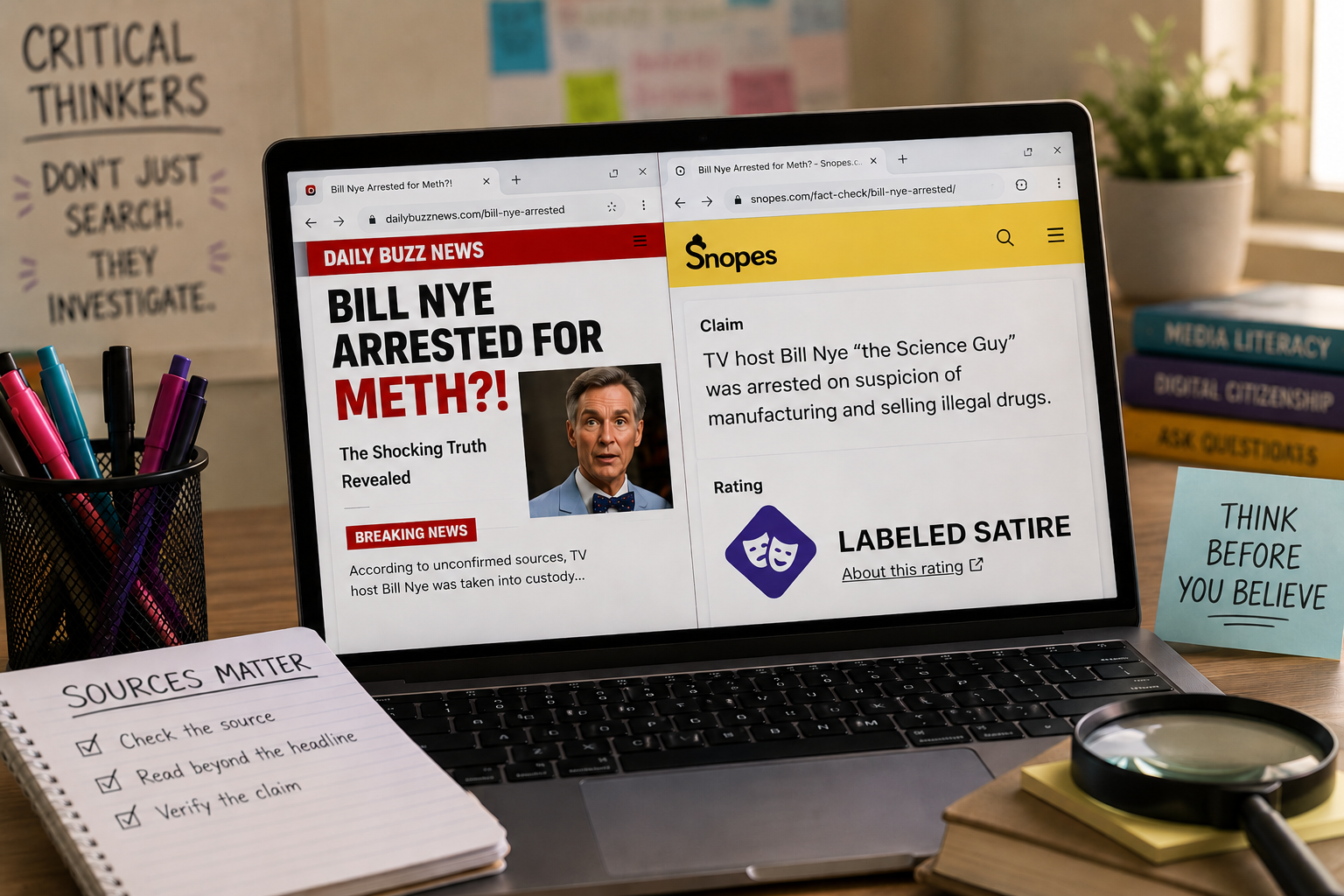
When Clickbait Becomes Evidence
One day, in the middle of a lesson, my students randomly decided it was time to reminisce about everyone's favorite TV scientist, Bill Nye the Science Guy.
How that began, I can’t say, but immediately a chorus of exclamations rang out:
“Those videos were so much fun!”
“Yeah… can we watch one right now?”
(I teach ELA… dang, these kids will do anything to avoid a grammar lesson).
“Did you guys know he was arrested for meth?”
The room goes silent.
“Excuse me?” I chime in.
I’m not ready for that part of my childhood to be tainted… We’ve all had celebrity heroes succumb to drug addiction, but Bill Nye the Science Guy? It couldn’t be true!
“Yeah! Look it up!”
Twenty Chromebooks fly open as students tap away at their keyboards. (One finger at a time, of course… another 21st-century skill that needs work.)
“It’s true! Look!”
I rush to see. The student’s proof?
A Reddit article.
Another student’s evidence?
Bill Nye, the meth guy… an animated YouTube short.
“If it wasn’t true, why would there be so many videos and articles about it?”
The most shocking piece of evidence a student provided as proof:
This screenshot from Snopes.com. 👇
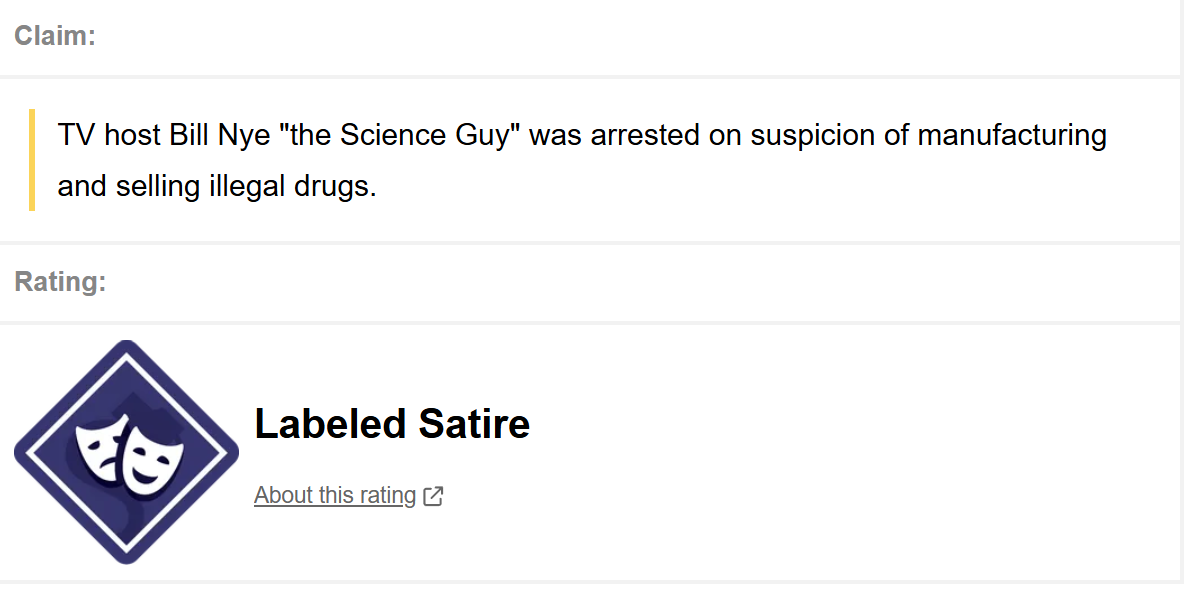
Fascinating…
A fact-checking website.
That clearly labels the article satire.
Oof.
I immediately abandoned that day’s lesson.
Not because I’d lost my students’ attention (though I had).
But because this was an authentic opportunity to address something more pressing.
My students weren't lazy researchers.
They did exactly what they’d been taught to do.
They searched for multiple sources.
They tried to verify the claim.
They even visited a fact-checking website!
On paper, they were doing everything "right."
They just never slowed down long enough to read what those sources were actually saying.
Instead, they saw three pages of results on Google and they were convinced…
Bill Nye had hit rock bottom.
At first, I thought they needed a lesson on satire—and certainly that would have helped— but the bigger issue was that they didn’t know how to evaluate the credibility of online sources.
Today, students are growing up in a world where anyone can publish a convincing website.
Heck—half the information online is AI-generated.
Headlines are designed to polarize. (I highly recommend Netflix’s documentary The Social Dilemma, which addresses this topic in depth.)
Satire is mistaken for journalism.
Search results reward popularity—not accuracy—and our students rarely realize the difference.
The internet has changed, and the way we teach research needs to change too.
In today’s world, students need more than a list of reliable domain names.
They need healthy skepticism.
Turning Source Evaluation into an Investigation
That’s why I stopped teaching source reliability as a simple checklist and started presenting it as an online investigation.
I put together a WebQuest that asks students to carefully investigate five wacky websites that are both highly engaging and middle-school-appropriate.
Some are real but seem fake upon first glance: the Mike the Headless Chicken website for example, while others are surprisingly convincing but fake: the Dihydrogen Monoxide (DHMO) site, which warns against a deadly chemical surprisingly prevalent in our daily lives.
According to the site, DHMO is…
A major component of acid rain.
Found in biopsies of pre-cancerous tumors and lesions.
Often associated with killer cyclones in the U.S. Midwest and elsewhere, and in hurricanes including deadly storms in Florida, New Orleans and other areas of the southeastern U.S.
The website is intentionally misleading.
The dangerous chemical?
Water.
The designer of this website set out to teach students the importance of reading critically and carefully evaluating sources online.
It’s a noble mission.
Really!
Because citing misinformation is so much more than a bad grade on a kid’s annotated bibliography.
We must give our students the resources they need to become the kind of people who pause before clicking "share,” read past the headline, recognize when they're being manipulated, and understand that just because something is posted on the internet doesn’t mean its true.
Because someday it won’t be about a grade on a research paper.
They'll be voting.
Serving on juries.
Raising children.
Making decisions that affect other people’s lives.
Digital literacy isn't just an academic skill.
It’s a moral necessity.
If this story hit a little too close to home, you’re not alone…
That's exactly why I created this Source Reliability WebQuest—to give students a chance to investigate real, fake, and misleading websites before those skills matter on a research paper... or in real life.
Build these skills in your classroom with my Source Reliability WebQuest!
Teach students the 🔴 red, 🟡 yellow, and 🟢 green flags to search for in online sources
Give them the opportunity to put those investigative skills to the test
Evaluate five wacky websites
Will your students be able to determine which information is real? And which is fake? The conclusions they draw will be revealing. You’ll know exactly what skills to revisit and reiterate!